
Culverts to Corridors
How culvert removal is bringing salmon back to Washington's streams
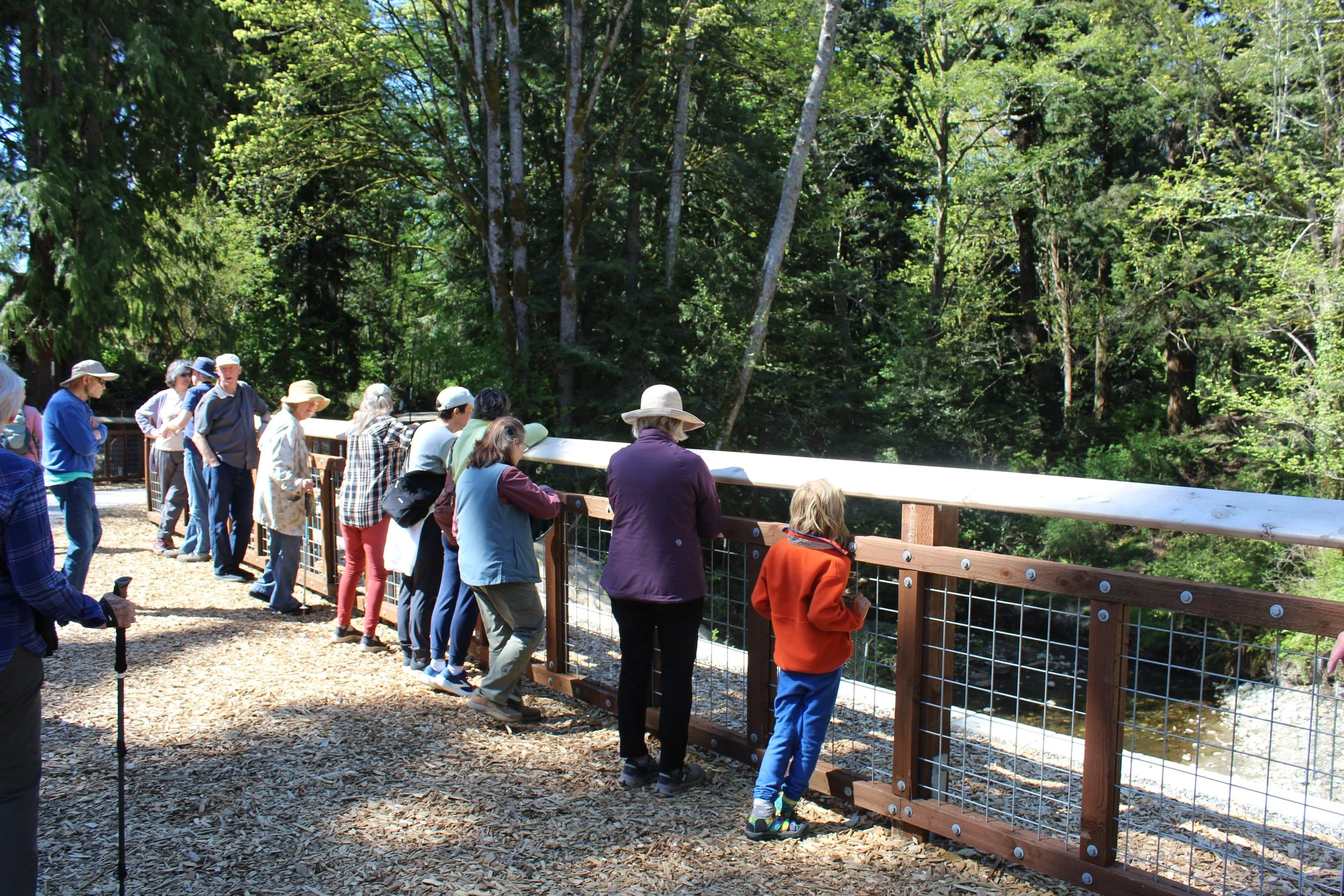
Bellingham community members look down onto Padden Creek and the newly restored 14th St culvert at a tour of the city’s fish passage restoration projects on Padden Creek on April 25, 2026. // Photo by Keogan Oakes
Story by Serena Herschleb // Photos by Keogan Oakes & courtesy of City of Bellingham & Anne Featherston
June 19, 2026
Under a tangled acre of blackberry vines, Rose Anne Featherston’s salmon stream went almost completely unnoticed for 30 years. When she first arrived on her farm in 1986, Featherston spotted a dead salmon in the creek. Without thinking twice, she didn’t revisit the stream until decades later, when the salmon returned, this time to stay.
Now, Featherston visits her stream regularly, watching generations of salmon begin and end their lives in the small tributary. Had her culvert not been removed, she never would have been able to appreciate this cycle of life.
Culverts create barriers that block the intersections between roads and streams, closing off waterways essential for fish passage.
Disentangling the tributary that weaves through Featherston’s farm is a small piece of the puzzle to restore salmon habitat connectivity around Bellingham.
On April 25, 2026, the city shared their recent restoration success with the Bellingham community during a tour of two new culvert replacements on Padden Creek. The event drew nearly 40 curious individuals, a testament to the community’s investment in healthy salmon populations.
This replacement opened the creek to six of its historical guests: chum, pink, coho, Chinook, steelhead and cutthroat salmon. Though the culvert improvements benefit all species residing in the creek, the project specifically targeted chum, which are notoriously weak swimmers.
“Some fish would get past them, especially the good swimmers: the steelhead, the Chinook and the coho. But the chum were having trouble,” Sara Brooke Benjamin, environmental coordinator with the city of Bellingham, said.
Completed in fall of 2025, the Padden Creek culverts at 12th and 14th street are among many projects by the city.
“The city has 126 crossings where roads or trails cross streams that block fish,” Analiese Burns, the habitat and restoration manager for the city of Bellingham, said.
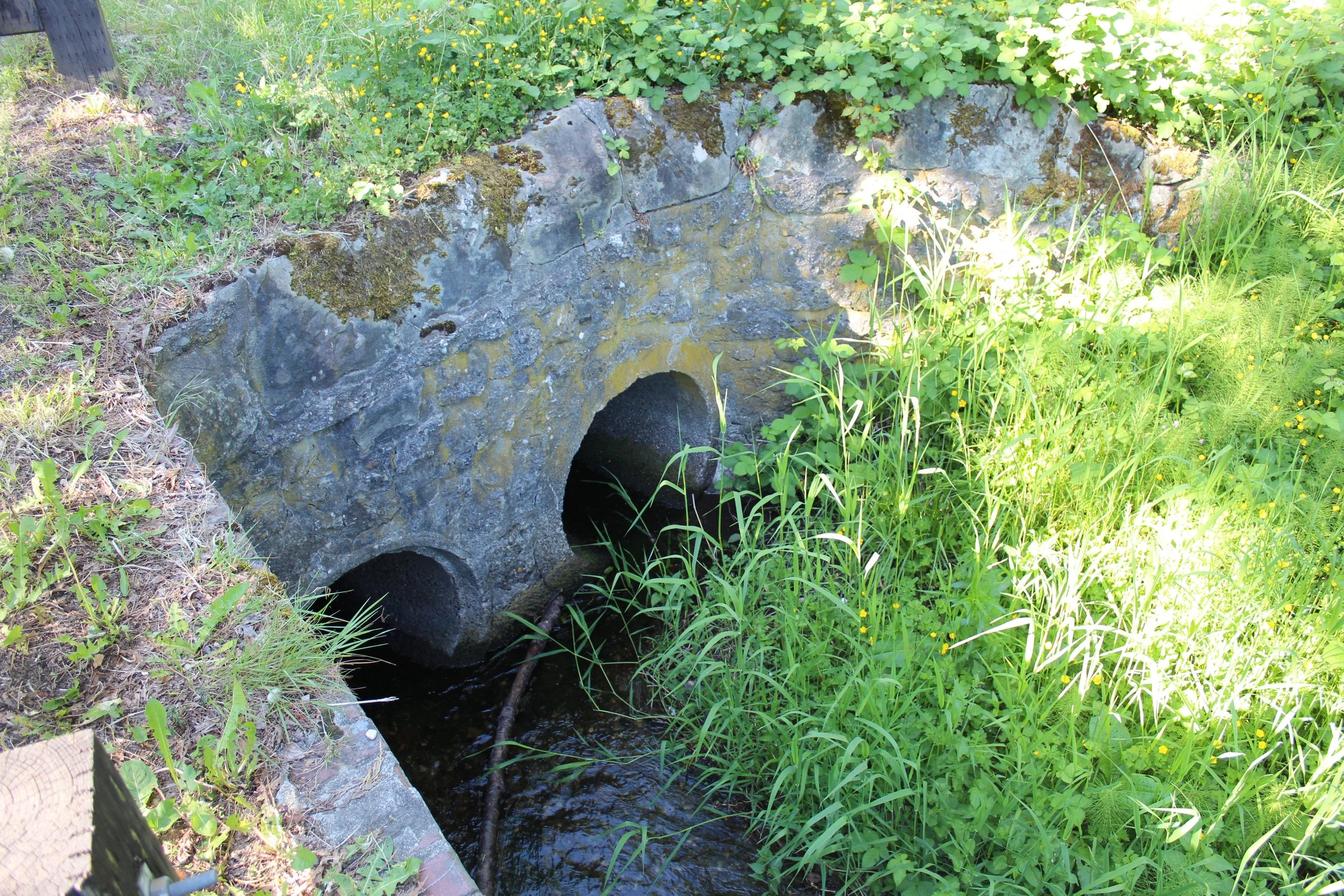
Among these is the next barrier salmon face when traveling up Padden Creek, which has yet to be replaced. Where the stream crosses under 30th street, a steep slope in the upstream direction limits passage.
This culvert is high on the city’s priority list and is currently in the design phase, one step closer to aiding salmon recovery.
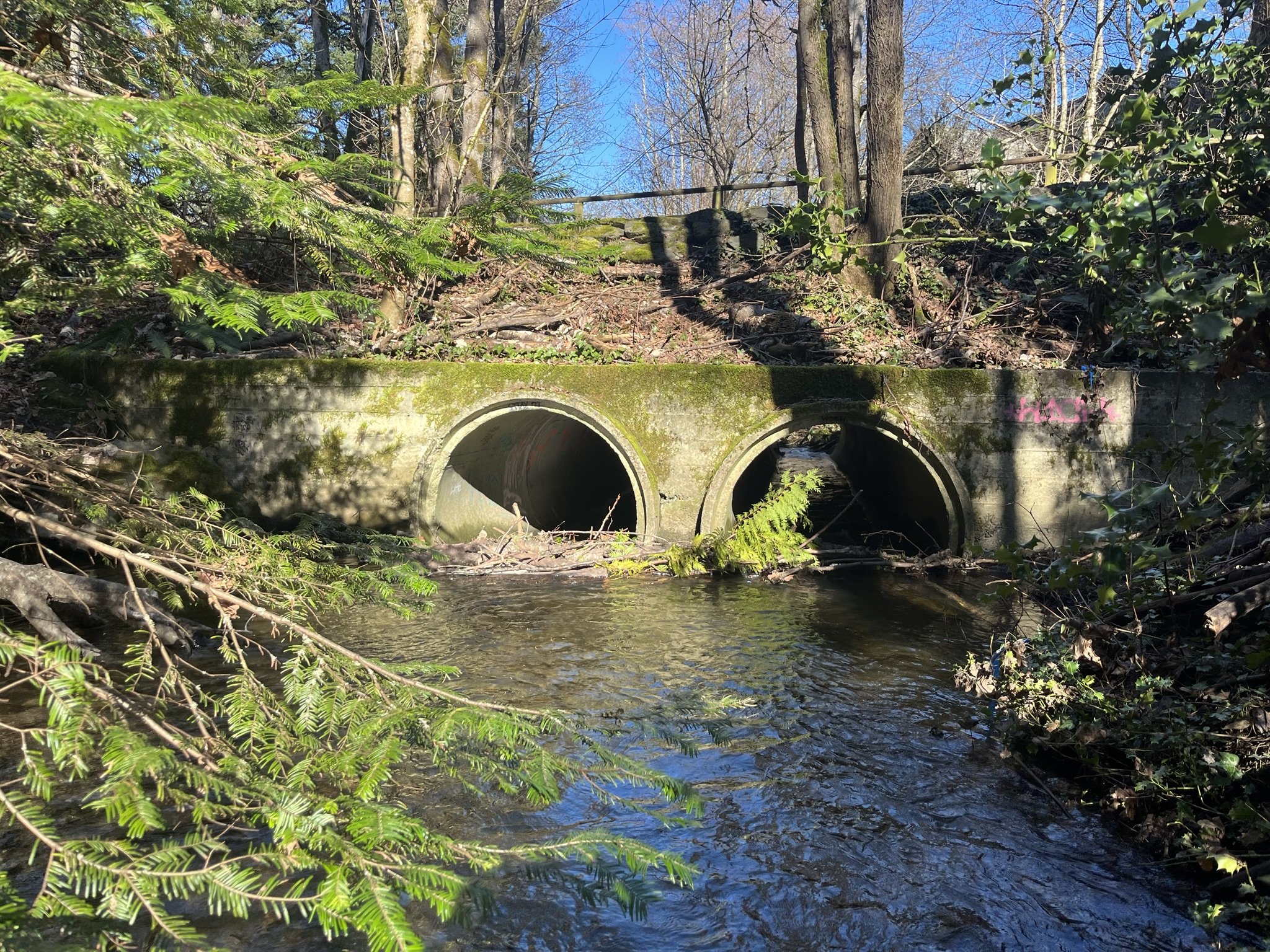
FIRST: Padden Creek and 14th St crossing before City of Bellingham culvert restoration began, 2024. // Courtesy of the City of Bellingham
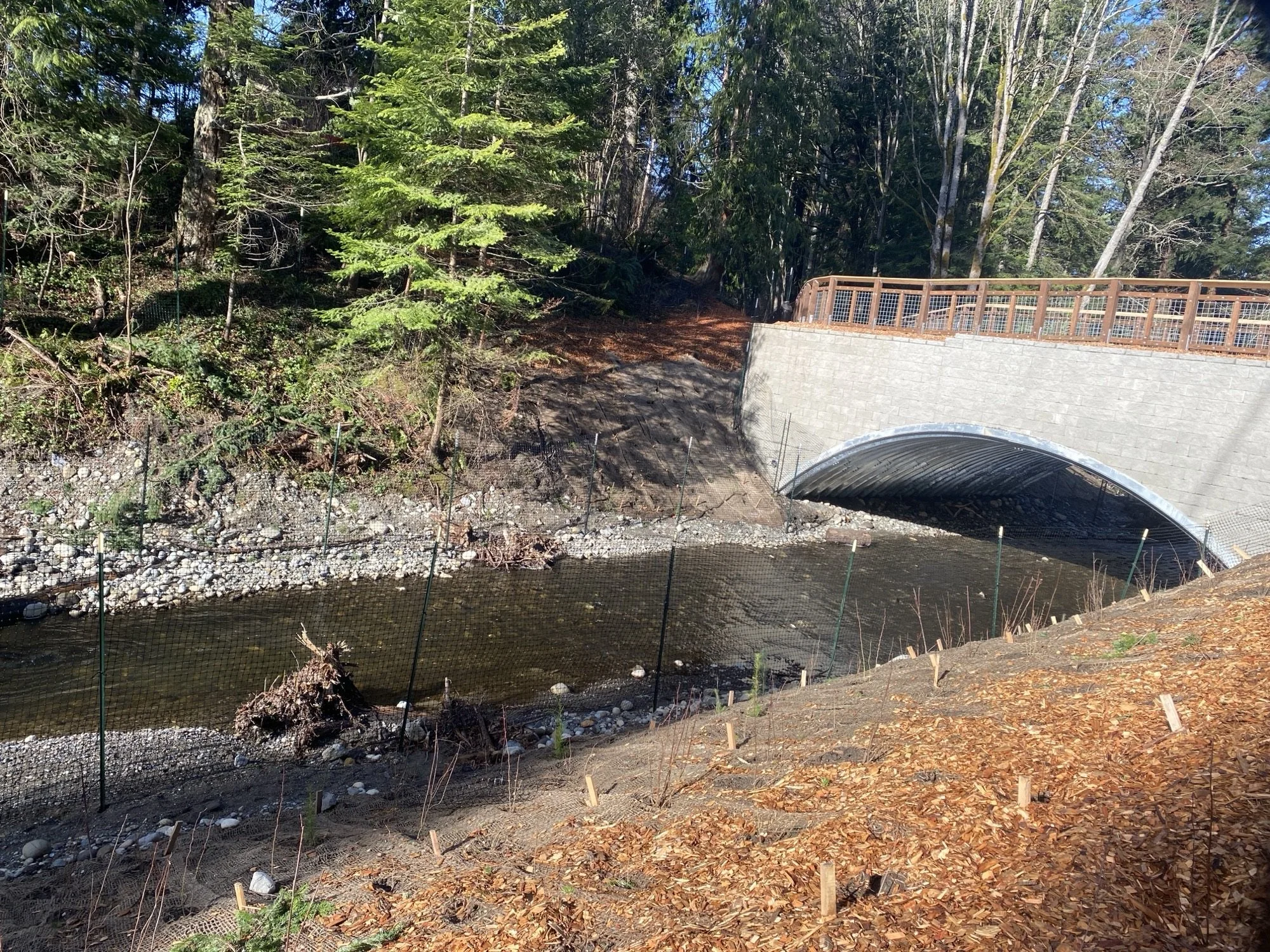
SECOND: Padden Creek and 14th St crossing on February 11, 2026, a few months after the culvert replacement was completed. // Courtesy of the City of Bellingham
THIRD: Inlet of the soon to be restored Padden Creek at 30th St culvert in Bellingham, WA, on May 25, 2026. // Photo by Keogan Oakes
A Basin-Wide Challenge
The entire Nooksack River Basin is a complex, winding network of 654 rivers and streams. Within this system, 195 culverts have been identified as blocking historic salmon habitat, including three species listed as threatened under the Endangered Species Act.
The economic, ecological and cultural importance of salmon is widely appreciated in the Pacific Northwest. Salmon have a unique life history that is vital in sustaining their surrounding ecosystems at each stage.
After years of enjoying the smorgasbord of critters available in the open ocean, salmon return to freshwater carrying marine-derived nutrients. As their bodies decompose in channels and on banks, these nutrients are incorporated into stream communities, supporting future generations of aquatic insects, juvenile fish and vegetation.
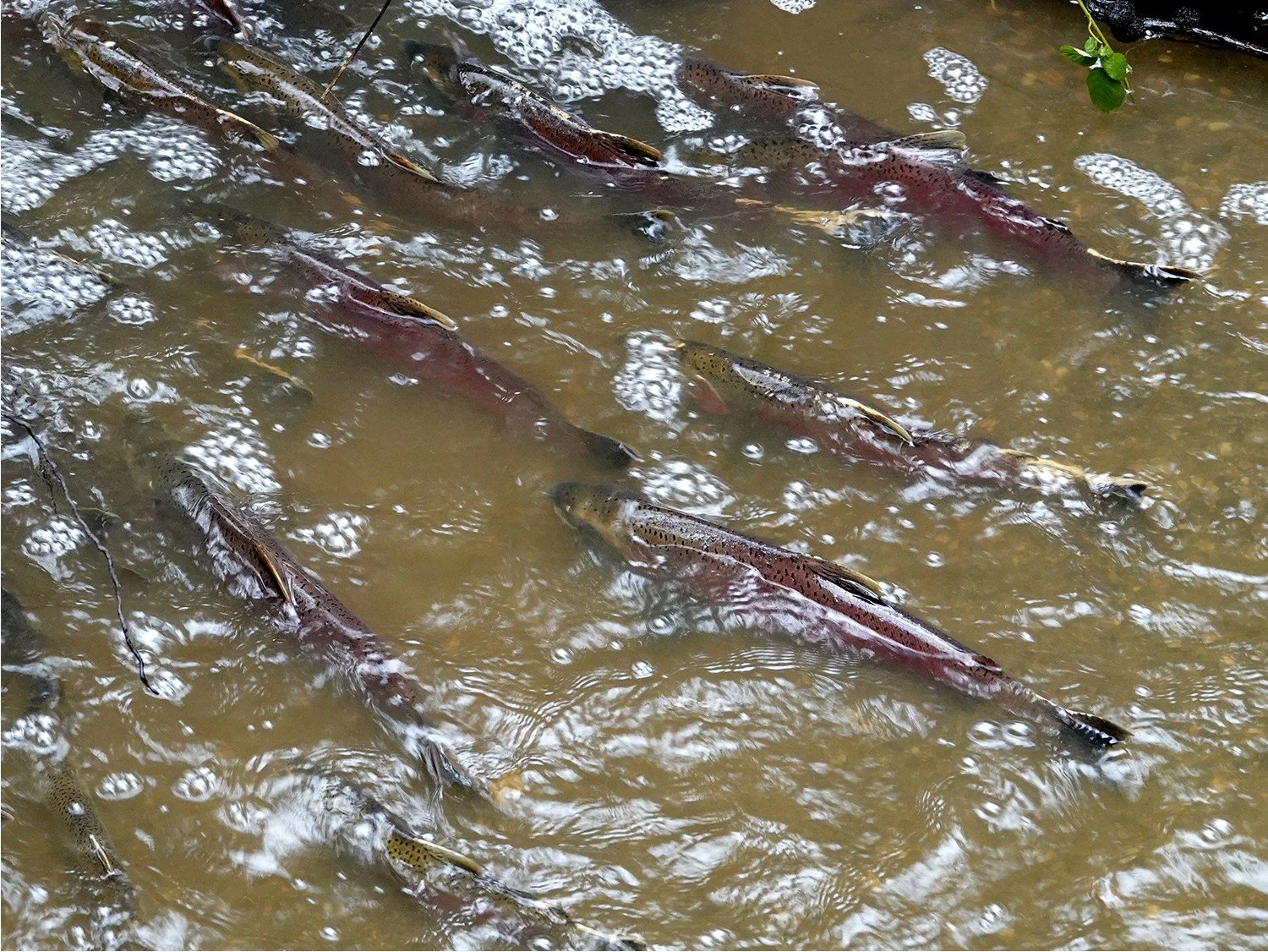
Spawning coho salmon in the tributary on Rose Anne Featherston’s property in the fall of 2025. // Courtesy of Anne Featherston
“It's nutrients for some kind of mammal or tree or bug, so I'm 100% on board,” Eli DeWitt, the in-stream project manager for the Nooksack Salmon Enhancement Association, said.
DeWitt’s work focuses on smaller projects on private property, usually replacing a poorly functioning culvert with a small bridge, including Featherston’s.
Now, Featherston is the president of NSEA’s board of directors, a role that she was inspired to take on after working with them to restore salmon access on her property.
“I called the executive director, and I said, ‘Look, I am so appreciative of what you all do,’” Featherston reflected. “Then a year later I was asked to join the board.”
Featherston now helps NSEA collaborate with the city on projects like the one they spearheaded years ago. But Bellingham is one city in a larger movement to replace culverts.
A Statewide Crisis
From the slopes of the Cascades to the estuaries where salt and fresh waters meet, salmon habitats in Washington are threatened nearly everywhere they collide with human nature.
In the state, around 4,500 miles of upstream habitat are inaccessible to finned residents due to poorly functioning culverts. While some salmon species linger near the mouths of their home rivers, others travel hundreds of miles, often through urban areas.
“There’s a lot of habitat out there that is still really quality habitat that fish just cannot get to,” Joel Ingram, a biologist from the Washington Department of Fish and Wildlife, said.
Poorly constructed culverts, along with the effects of agriculture, logging, urban development and dam construction, are having detrimental impacts on salmon habitat and therefore salmon populations in Washington.
“The number of salmon, at least natural wild salmon, has gone from something like 30, 35 million in the state down to about maybe 5 million wild fish,” Tom Jameson, chair of the Brian Abbott Fish Barrier Removal Board, said.
In the race to protect salmon populations, barrier removal is the best hope.
“As far as fish passage goes, our scientists here in the Department of Fish and Wildlife said it's the restoration technique or restoration option that we have the most confidence is going to help recover salmon,” Jameson said.
A Legal Mandate
There are many motivations for completing barrier-removal projects, but the strongest impetus comes from the state’s legal obligation.
“The state of Washington was sued by the tribes for violating tribal treaty rights for blocking fish to access their habitat,” Burns said. “If tribes have the right to fish, then that assumes that there are fish to fish.”
The 1974 Boldt Decision affirmed tribal treaty rights to fish at their “usual and accustomed grounds,” the right to 50 percent of the allowable catch and established the tribes and state as co-managers of salmon. However, with dwindling salmon runs and barrier-ridden streams, historic tribal harvests are not being met.
Under a 2013 federal court injunction, the state is obligated to remove barriers to restore salmon harvests to historic levels. The ruling, which was upheld five years later, established that the state must repair 90 percent of culverts that block salmon migration by 2030.
With between 18,000 and 20,000 barriers in the state’s inventory, only a small fraction have been completely fixed. So far, the Department of Transportation has repaired 200 barriers, with 150 more expected to be completed between 2031 and 2033. Other state organizations are working on replacing culverts under their jurisdiction, including the Departments of Fish and Wildlife, Natural Resources, State Parks and the Recreation Commission.
The Price Of Progress
These projects cost taxpayers anywhere between $2 million and $9 million, depending on size and scope. Smaller projects such as NSEA’s, which are completed on fragments of tributary habitat, can cost upwards of $150,000.
This price tag is only going up.
Sunny Jardine is a resource and environmental economist at the University of Washington who co-created Upstream, an online tool that allows salmon managers to determine which barriers in their inventories are optimal for restoration based on their available funding.
Upstream’s optimization approach is rooted in cost-effective ecosystem-based management, where every barrier in the system from mouth to headwaters is considered.
“There might be some great habitat that you want to open up that's upstream, and it's got natural watersheds, shady, great sediment, everything you like about it, right? But you might have to, in order to even unlock that, open up some culverts that are in the middle of an urban area,” Jardine said.
While culverts in pristine, upstream habitats hold the greatest appeal, downstream barriers may need to be restored first, allowing passage to the most ideal locations.
To ensure that the highest priority projects receive funding and are completed first, the state performs a rigorous culvert assessment.
The process of assessing and inventorying culverts isn’t glamorous, but it is necessary. Caroline Slagle worked for the Department of Fish and Wildlife on inventory and assessment for nearly a year.
“It can get quite monotonous,” Slagle said.
After finishing up at one site, Slagle sometimes wouldn’t make it more than 100 feet down the road before hopping out of her car to assess the next culvert. Despite spending weeks on end in this routine, she finds great fulfillment in her work.
“I've gotten to see salmon return upstream of some projects,” Slagle said. “It takes a couple years for funding and projects to get on the ground, but it is tangible work, and that's rewarding.”
Results That Come Fast
What makes culvert replacement unique among many other habitat restoration efforts is that it’s fast-acting.
“When that barrier is removed, the results are almost immediate,” James Helfield, an environmental science professor at Western Washington University, said.
The same fall that her culvert was removed, Featherston’s stream was flashing with the reds and greens characteristic of spawning coho salmon.
“It was three weeks later… I had salmon in my creek,” Featherston enthusiastically explained.
Fish are already moving through the recently restored Padden Creek culverts, making their way further upstream than was previously possible.
The work to free Washington’s waterways from fish-blocking barriers is far from complete, but the momentum is strong. With state and local governments, non-profits and the tribes turning their attention to barrier removal as the most effective means of habitat restoration, progress is accelerating.
“This is good for the landowner. It's good for fish. It's just good for water quality. It's good for the environment. You know, it's a win-win, win-win, win,” DeWitt said.
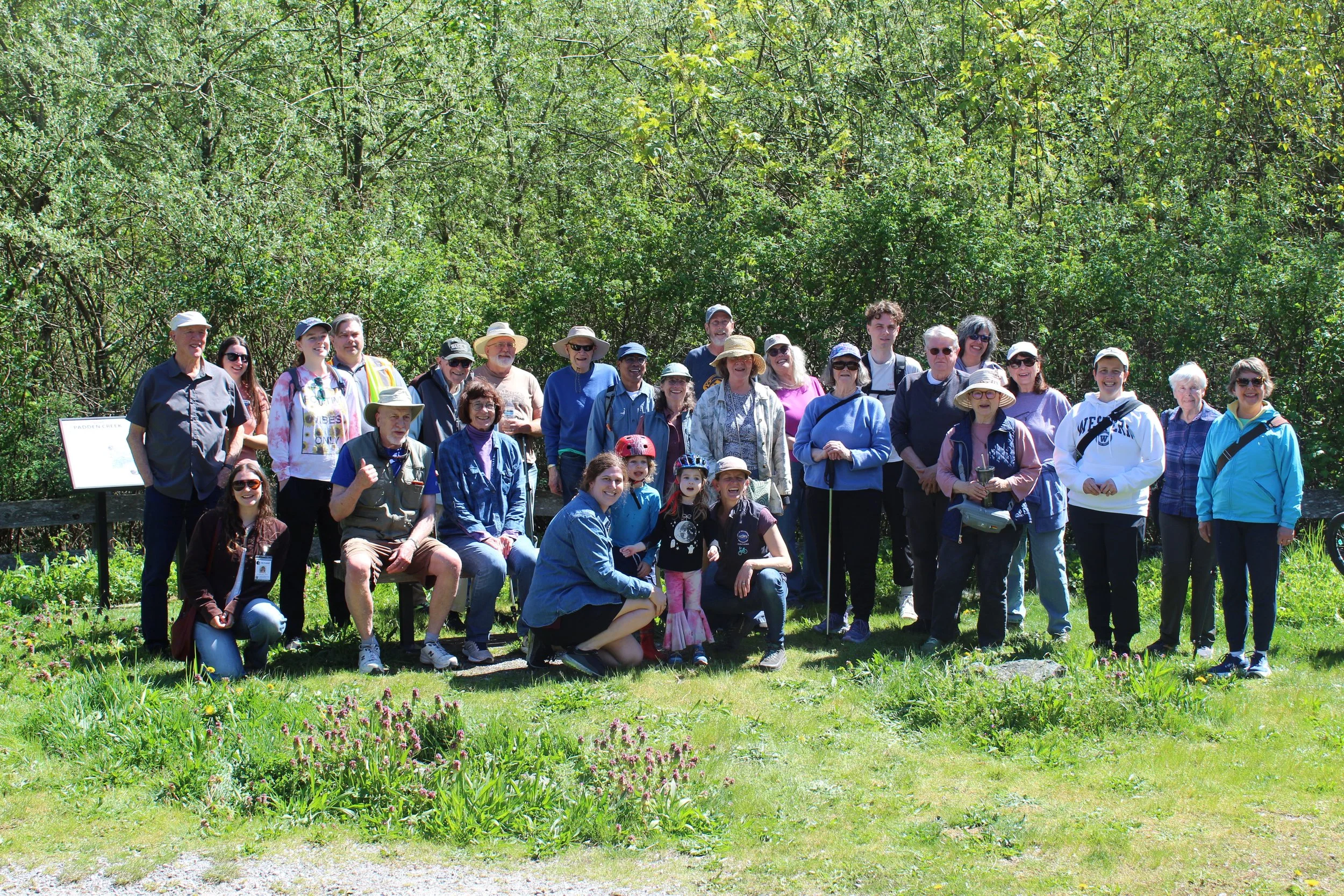
Community members pose for a group photo at the beginning of the City of Bellingham’s tour of the restored Padden Creek culverts on April 25, 2026. // Photo by Keogan Oakes