
The Lost Giant of the Salish Sea
Despite rebounding in other oceans, basking shark populations remain a rarity in the Pacific Northwest
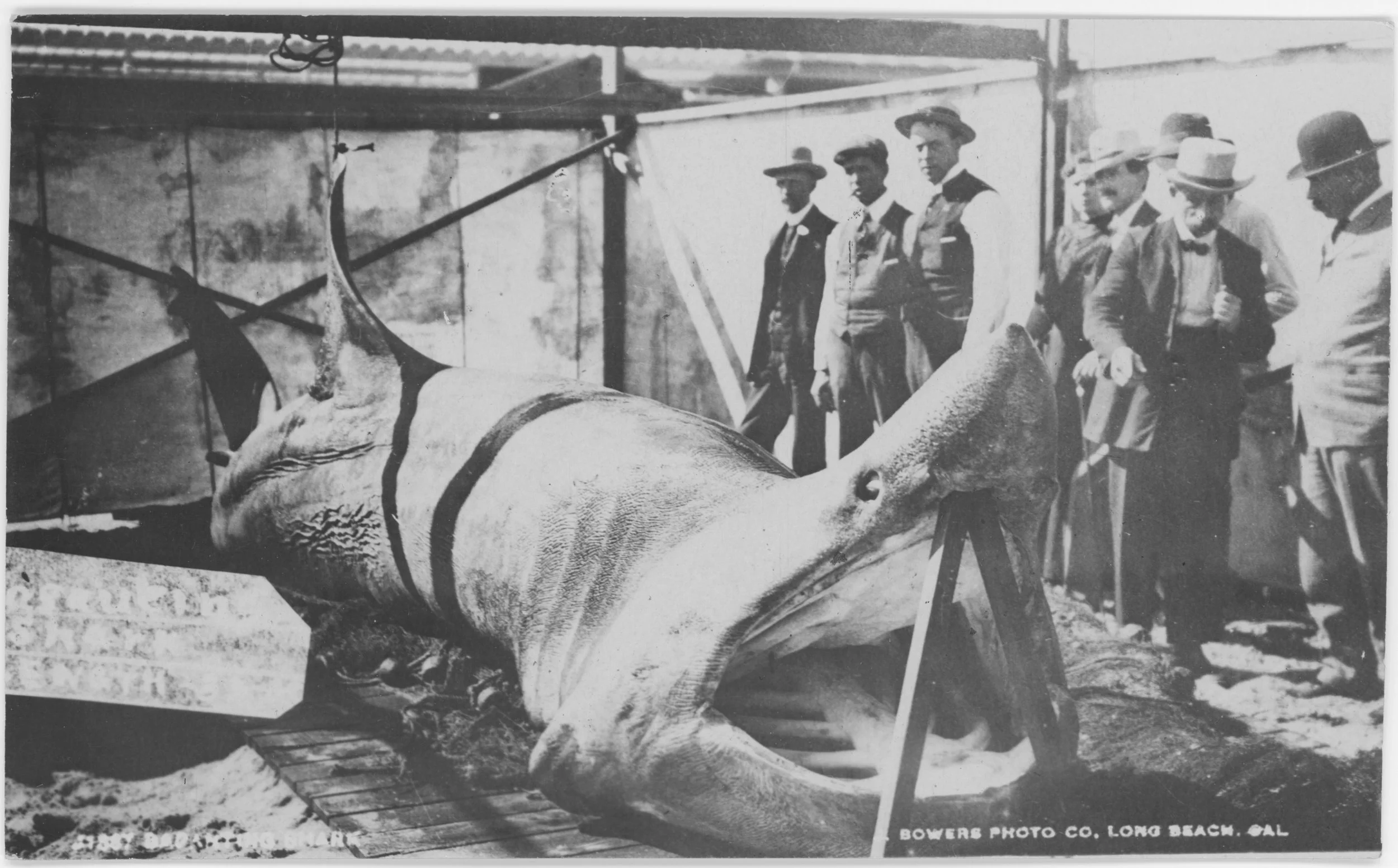
A basking shark propped up with wood planks for onlookers. // Photo by Bowers Photo Co.; Courtesy of Whatcom Museum
Story by Jamison Hasemann // Photos courtesy of the Whatcom Museum & Basking Shark Scotland
June 19, 2026
A fin slices through emerald water, slow and striking, followed by an impossibly large shadow beneath the still surface. Its gaping mouth stretches wide as it drifts through rays of sunlight and filters the ocean.
This was once a common sight in the Salish Sea.
Basking sharks, the second largest fish on Earth, once gathered here each summer, drawn by dense blooms of plankton. Within the last century, they were hunted until sightings dwindled into rarities. Today, while countries like Scotland and Ireland celebrate their return through tourism, research and conservation, the presence of these giants in the sea has largely been forgotten.
“Very few people realize they should even be here historically,” Sam Murphy, a naturalist and captain of eight years, said.
Growing up to 40 feet long, basking sharks move slowly through the water with their mouths wide open, straining with their comb-like gill rakers. Despite their size, they feed on some of the smallest organisms in the sea and are harmless to humans.
Historical records describe groups of these sharks gathering in large numbers during warmer months. Some reports describe so many sharks crowding the surface that their broad grey bodies brushed and bumped against hulls like logs drifting in the tide.
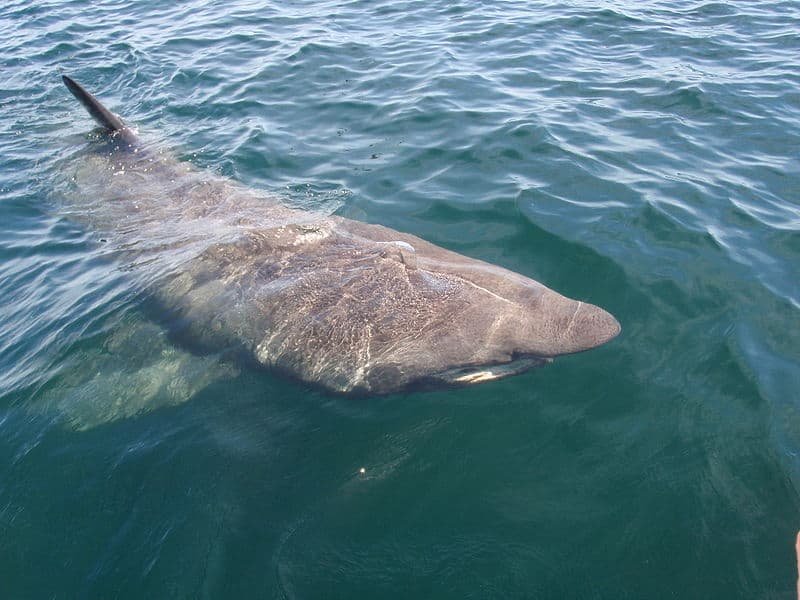
A basking shark breaks the surface of the water. // Courtesy of Rossbeane via Wikimedia Commons
Their size made them impossible to ignore.
By the mid-1900s, basking sharks had developed a reputation as nuisances. Fishermen were angered by sharks damaging gear and interfering with salmon catch.
In Canada, eradication campaigns were launched to intentionally remove them from coastal waters. Efforts ranged from targeted fishing to far more brutal methods. One government-funded program operating near Barkley Sound used a blade mounted to the front of a boat to slice through basking sharks encountered at sea.
“In the conversations I do have with passengers, when it comes up, usually it’s shock and disappointment when we discuss the brutal history,” Murphy said.
Today, basking sharks are considered endangered in Canadian Pacific waters. Researchers estimate the eastern North Pacific population has fallen under 600 individuals.
The waters appear differently elsewhere in the world.
Basking sharks return each year off the coasts of Scotland and Ireland with the warming season, tracing ancient migration routes through cold Atlantic water. Their dorsal fins arc across the surface, drawing tourists, researchers and photographers out to sea to witness them feeding. In some Scottish coastal communities, the sharks have become symbols of marine conservation and ecotourism. Videos capture their powerful breaches out of the ocean, and tourists travel specifically for the chance to observe this behavior.
Yet in the Salish Sea, many residents have never heard of basking sharks. The idea that enormous filter-feeding sharks once gathered here in astounding numbers sounds fictional, more myth than memory.
For many marine species in the Pacific Northwest, visibility inspires conservation. Orcas have become internationally recognized symbols of the Salish Sea; salmon connect ecosystems and define regional identity; sea otters' importance as a keystone species is taught widely and there is effort to preserve their remaining populations.
But basking sharks exist mostly as an absence — an outline in the ecosystem where an enormous creature once claimed space.
“These stories are so important to put the ecosystem and the timeline that we see things in perspective,” Cindy Elliser, associate director of the Salish Sea Institute, said. “We are very easily, by generation, able to forget things that happened before because it’s not in your everyday life.”
Elliser is also part of a “basking shark enthusiast group,” formed by local scientists and researchers in 2024. The group works to structure future conservation, research and outreach about basking sharks.
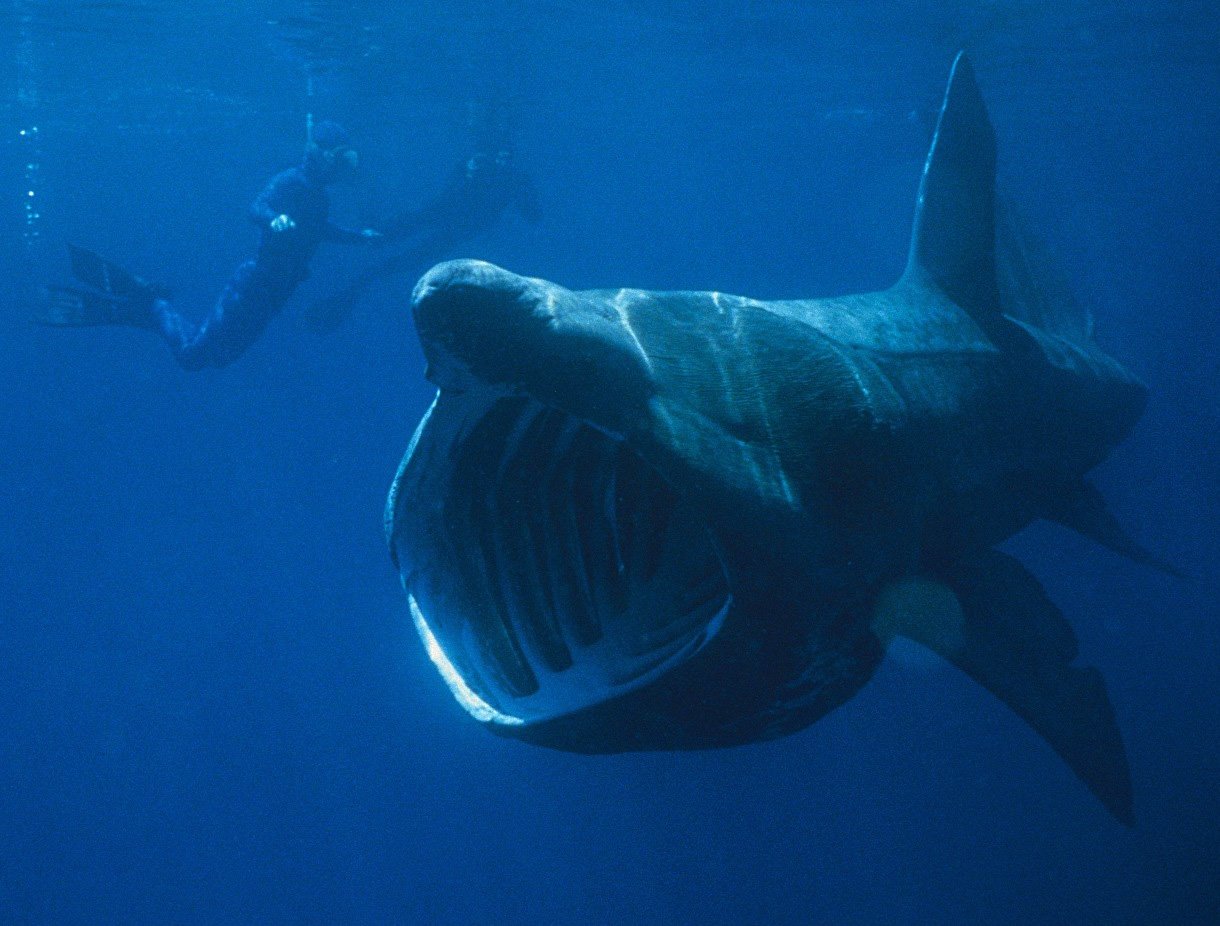
Snorkelists watch as a basking shark filter feeds below the surface. // Courtesy of Chris Gotschalk via Wikimedia Commons.
Researchers still do not know whether the small number of sharks occasionally seen near the Salish Sea belong to a recovering local population or are transient individuals passing through from elsewhere in the Pacific.
Jim Darling recalls when there were still enough basking sharks to count. Darling worked with the Clayoquot Biosphere Project in the 1990s to identify individual basking sharks based on their dorsal fins. Encounters were consistent at first, but year after year, numbers began to dwindle. The team planned to tag the sharks to better understand where they traveled, but by the time they were prepared with equipment the sharks had vanished from the area.
Darling believes the government cullings alone do not fully explain the disappearances. No dramatic environmental shifts stood out over time, but the rapid growth of fisheries across the region did. Basking sharks are especially vulnerable to entanglement in large offshore nets used by commercial fisheries because they swim just beneath the surface.
The uncertainty surrounding their decline raises a difficult question for conservationists of how to recover a species people barely recall.
“We really just haven’t seen them in the Pacific Northwest [since the 70s],” Dayv Lowry, a fish biologist with the National Oceanic and Atmospheric Administration, said. “If they’re not really here, what are we going to do about it?”
Occasional sightings further down the West Coast still occur. In March, as the sun was setting off the coast of San Diego, Jack Elstner, a doctoral student studying biological oceanography and fisheries science at Scripps College, spotted a large fin breaking the surface. This particular basking shark was estimated between 25 and 30 feet in length.
“I never thought that I would see one in my lifetime because they are such a rare sighting,” Elstner said. “It was a really special moment to see an animal like that up close and personal.”
Although neighboring waters have appearances, basking sharks mature slowly, reproduce infrequently and may carry young for several years before giving birth. Scientists know surprisingly little about where they breed, migrate or spend their time while beneath the surface.
“They’re a really challenging animal to study, so that's what makes assessing recovery or population declines through time challenging,” Elstner said.
Even in an ideal environment, population recovery could take decades, and time is of the essence.
The conditions that once brought basking sharks to the Salish Sea still return each year. Summer light stretches late across the water. Plankton blooms spread beneath the surface like clouds suspended in green glass. The ecosystem still creates the ideal moments where these giant filter feeders could exist.
But the sharks do not come.
The question lingering beneath the surface of the Salish Sea is no longer simply where the basking sharks went. It is whether there is still time for them to return.
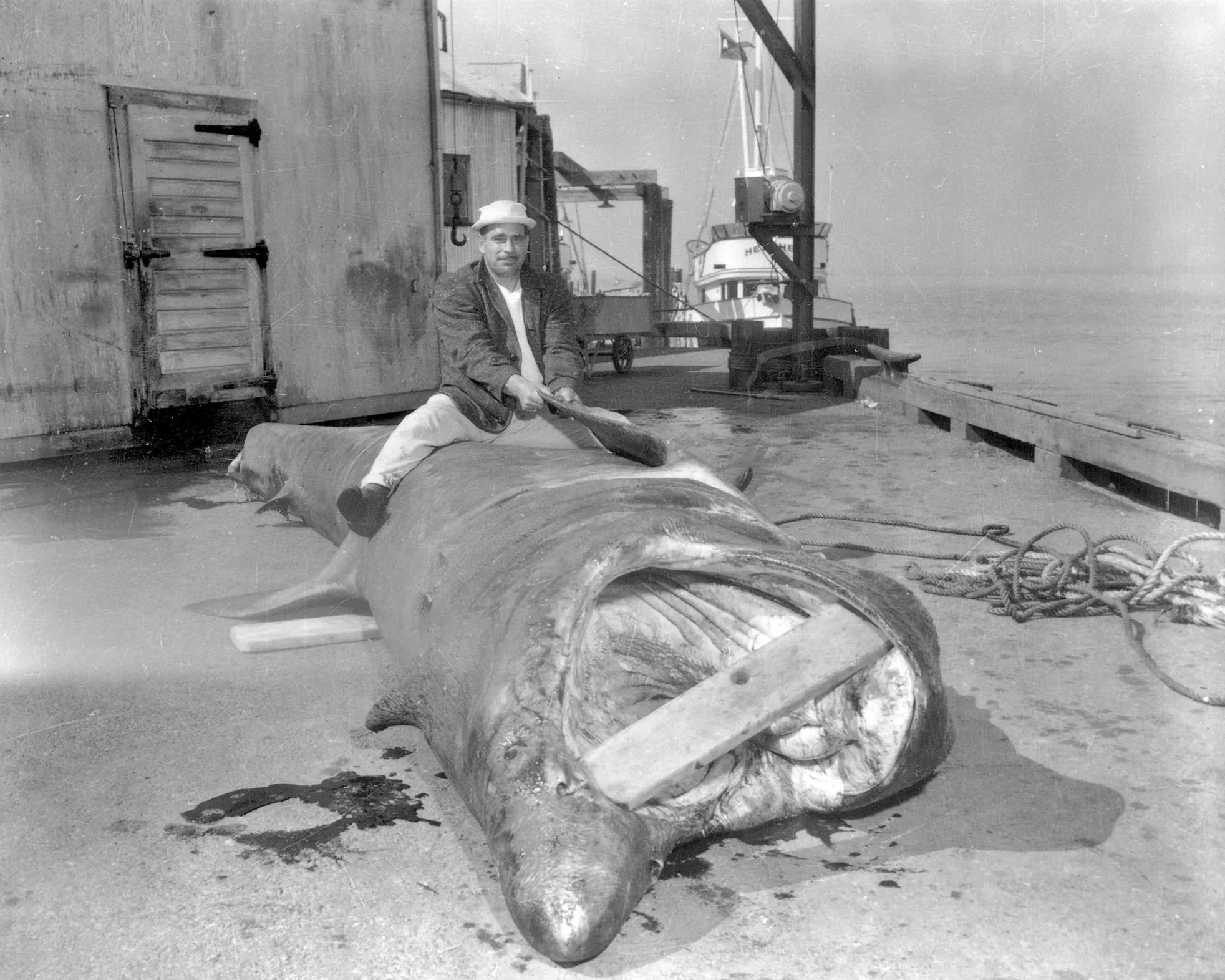
A man sitting upon a captured basking shark in 1962. // Photo by Jack Carver; courtesy of Whatcom Museum