
A New Home for Nesting Herons
An estuary restoration project creates unexpected habitat for herons in Little Squalicum Park
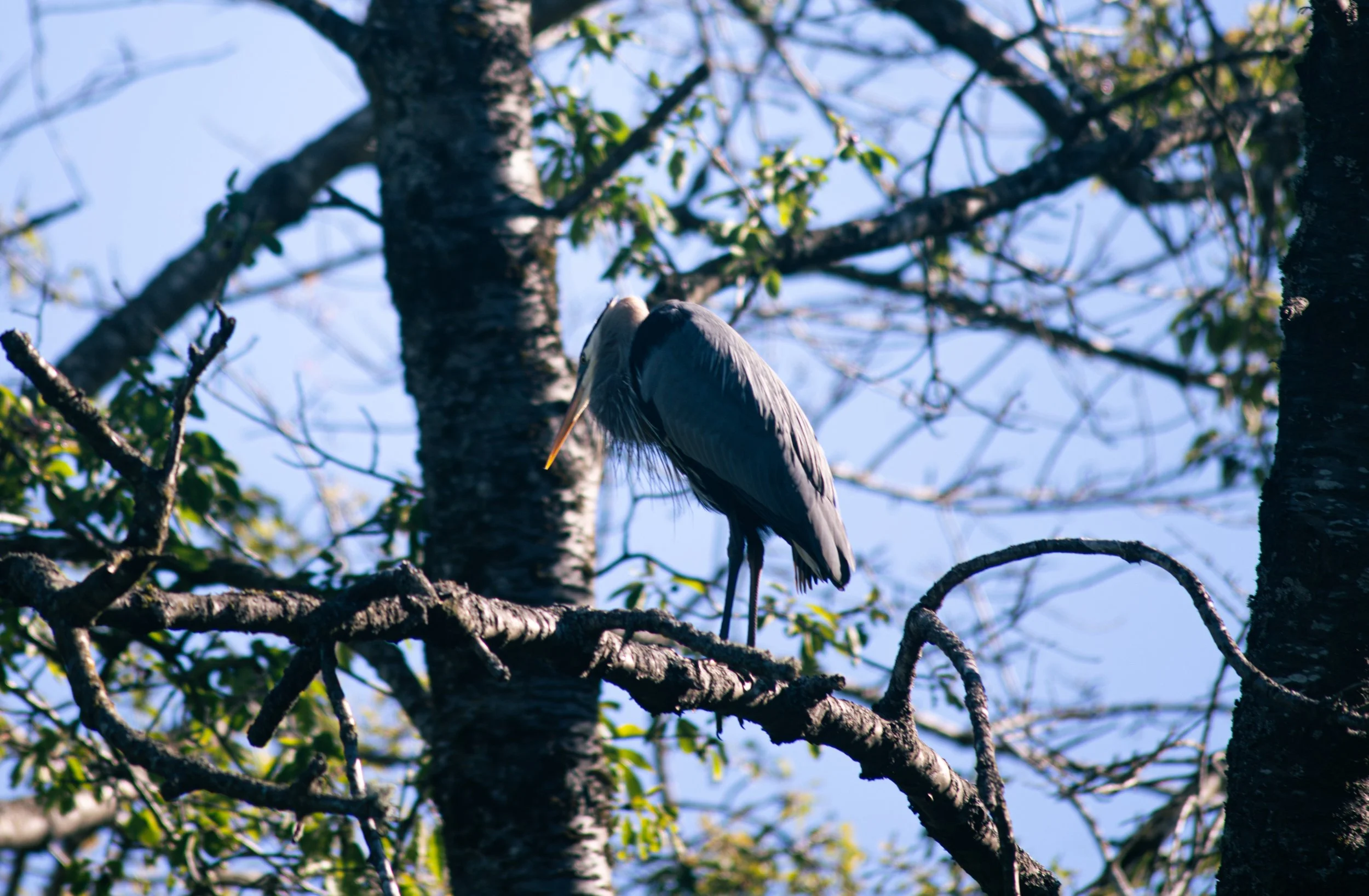
Heron Roosting on a tree branch about 20ft in the air at Little Squalicum Park June 14, 2026 // Photo by Avery Robertson
Story by Lily Rodgers // Photos by Avery Robertson
June 19, 2026
Just barely across the northern border of Bellingham, Washington, Little Squalicum Park sits in a small valley, with a creek winding its way through the trees. The creek blossoms into an estuary, which pours into the bay, providing sweeping views of the city while waves gently break on a rocky beach. People bike along the trails, dogs run untethered from their owners, bird watchers peer into the lush canopy, perhaps a frisbee is thrown by some boisterous college students. It is a quintessential Bellingham scene.
Possibly the most striking element of this scene is the great blue herons, magnificent birds standing perfectly still on the water’s edge. People slow and watch as one poises to strike. In a second, she snaps up a fish and takes off; parkgoers crane their necks to watch her return to her nest. Among the trees, other nests hold expecting parents and their eggs — a community of fascinating birds right above the park.
Beginning in spring of 2025, people began to take notice of the new herons.
These large birds perform elaborate mating rituals with around 14 different calls and displays. The spectacle drew attention quickly. In collaboration, the pairs began constructing their nests. Birds once easily recognized standing alone on the shoreline were now building a little neighborhood.
As young herons fledged the nest, biologists declared the site a new colony.
Around this time, foot traffic near the colony prompted the city to put up fences, creating a 300-foot buffer. Giving the birds their space reduces the chances that an adult heron will abandon their nest.
“It’s fun to see these large nests with huge birds in a relatively small tree and fairly close to human activity,” Analiese Burns, the city’s habitat restoration manager, said. “It’s pretty surprising how much they can get used to and tolerate.”
Herons’ nests are nearly as impressive as they are, reaching 4 feet long and nearly 3.5 feet deep. Remarkably, despite their size, oblivious passersby may not even notice the nests hidden in the branches so close to the path.
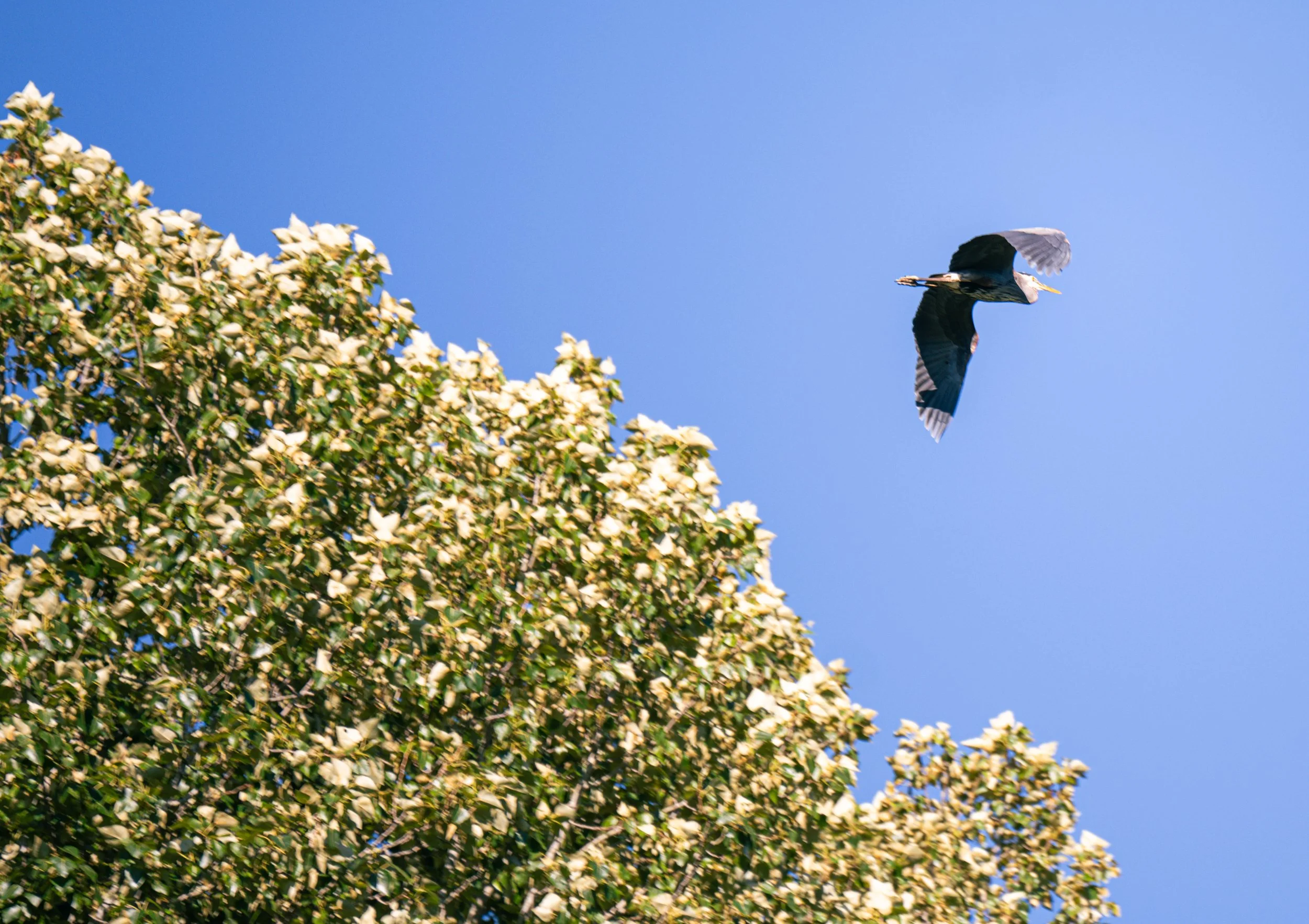
Great Blue Heron soaring over their nesting grounds at Little Squalicum park June 14, 2026 // Photo by Avery Robertson
But this park’s picturesque moments are not representative of its past. The land that is now rich with native vegetation and a healthy estuary was once stripped down and exploited for gravel. The former Superfund site, contaminated by the local wood treatment center just above the park, is a beautiful example of successful restoration.
The Little Squalicum Park Estuary project began in 2008 and was completed in 2024. This project aimed to provide new habitat for endangered Chinook salmon by creating a space for juveniles to grow and feed before heading out to sea. But the target species was not the only beneficiary.
A brand new colony of great blue herons formed in March of 2025, less than a year after the construction was completed.
Nestled in a park surrounded by urban noise, pedaling pedestrians and a busy train bridge cutting through the valley, it is not clear why exactly these herons chose Squalicum as their next destination. All biologists know is that they want to stay — but to do that, they need quality habitat.
Heron habitats need to be complex and provide essential materials for creating nests. Estuaries, both small and large, provide complex habitats with high nutrient influx and abundant prey for herons. But herons were not a focus of the original estuary design.
In 2008, while the project was being conceived, Jim Johannessen, the current senior principal coastal geologist at Natural Systems Design, began his involvement with the Little Squalicum Park project. Working with several groups, including the city of Bellingham and Coastal Geologic Services, they devised a plan.
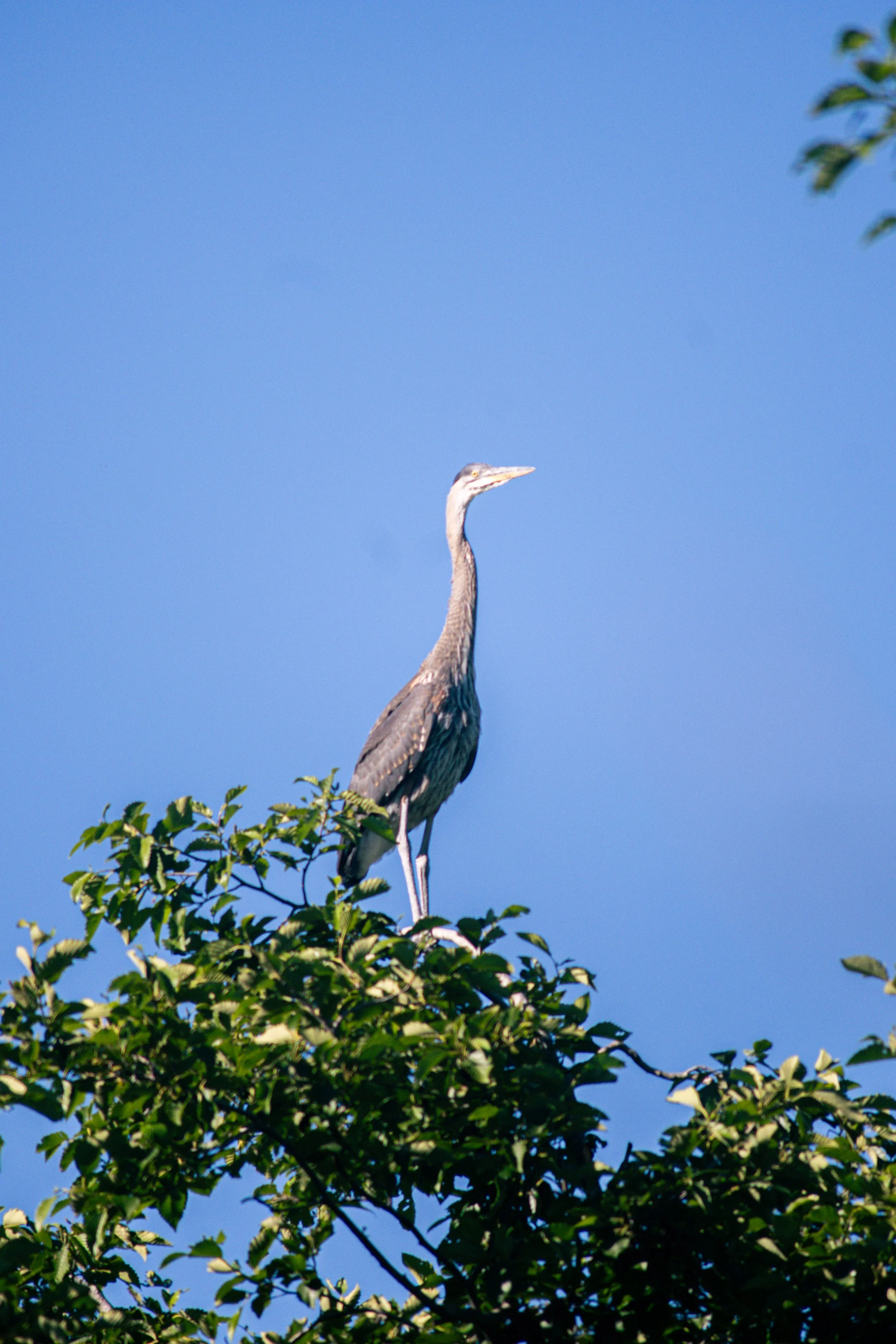
Heron perched atop a tree in Lille Squalicum Park June 14, 2026. // Photo by Avery Robertson
At the time, the shoreline was covered in eroding concrete bridge debris. With some cleanup funds from the Bellingham Bay Action Team, an idea emerged to assess the area and create a new habitat.
“Estuaries are critical habitat for juvenile salmon in particular, and sometimes adult salmon, a lot of birds [and] a lot of other species,” Johannessen said.
The city of Bellingham was a major player in advancing the plans. Burns explained that part of the goals were to restore lost estuarine habitat, enhance sediment supply, enhance wetland water quality function and remove contaminated soils. These factors are all beneficial for salmon, but also for the ecosystem as a whole.
Accomplishing these goals was no simple task. Endless permitting and the search for funding created hurdles, causing delays. From conception to completion, the project cost over $6 million and took 15 years.
A significant long-term construction project within a busy park may look like a laundry list of delayed gratification. But many Bellingham residents are in favor of restoration projects. Demonstrating their support, people from all walks of life came to native planting work parties. Having a new path with views of the estuary was deemed valuable for wildlife and parkgoers alike.
“The fact that it’s being properly restored [and] ecologically sound… that’s great,” Jackie Caplan-Auerbach, a parkgoer, said.
The hustle and bustle of the park only grew once the construction was completed. Heron colonies in busy areas are not a new occurrence in Bellingham. The Post Point colony near Marine Park has been established for 26 years and has over 40 nests. The city has monitored these colonies for years, amassing a wealth of data on these large birds. While it cannot be said for sure, as the herons are not banded, scientists assume that the new colony is a branch off of Post Point.
When the new colony was established in Little Squalicum, the monitoring was extended there as well.
During the breeding season, biologists visit every two weeks to check out the colonies. The staff biologists note when the herons arrive, the number of nests, when the birds start incubating and general heron behavior.
The fascinating world of the heron is not known to many. But with more signage and fenced-off areas, more people are beginning to get excited about their feathered neighbors.
“You just feel like you’re coming back into the Cretaceous or something. And that is wonderful,” Caplan-Auerbach said. “Whenever you have something in nature that captures everybody's attention, whether or not it's a known interest of theirs, I think that's doubly nice.”
With current changes in government spending, restoration projects are being put on the back burner while other issues take precedence. But the ripple effect of successful restoration can even cause benefits to species that are not a high priority.
As of spring, the Little Squalicum Park colony is in the thick of their breeding season. Visitors to the park can catch glimpses of the young birds in their nests and hear them call to their doting parents. As the summer rolls through, the babies will learn to fly, taking a leap of faith from the tops of trees. They will join their families on the shoreline of the estuary, unaware of the efforts it took for their home to be what it is today.
“We live in this beautiful place where the ocean is interacting with the shore and that gets complicated,” Burns said. “It's not always doom and gloom; we are building back some of those lost habitats, and there are areas that are improving in our lifetimes. And it takes all of us to care for it and appreciate it for it to happen.”