
The Lingering Legacy of Creosote
The contaminant that was once pivotal to Eagle Harbor now poses a community challenge
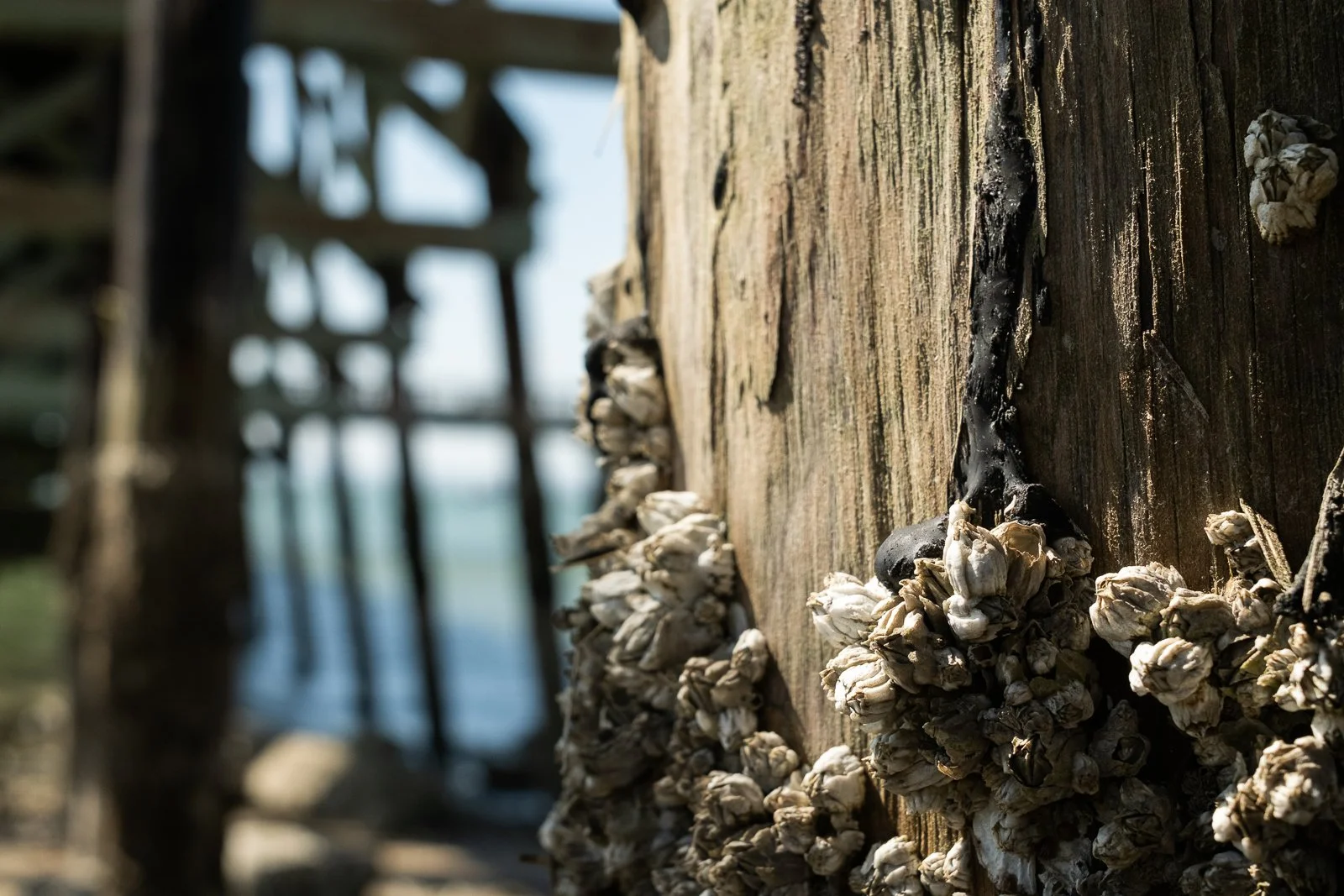
Photo of a piling at Taylor dock with creosote dripping onto barnacles. // Photo by Evan Coleman
Story by Marissa Steward // Photos by Evan Coleman & Marissa Steward
June 19, 2026
It was a sweltering summer day on Bainbridge Island when Sydney Akers, the stewardship coordinator for the Bainbridge Island Land Trust, strode into the office. The second floor windows, perfectly positioned to catch a breeze, were left ajar to alleviate the heat.
As Akers walked through the office, a pungent odor lingered in the room. The smell was so concerning that she worried for her safety and that of others. After alerting everyone in the building, Akers and her coworkers evacuated.
Across the bay, less than a mile from the office, rests the origin of the chemical stench: Eagle Harbor, formerly home to one of the largest creosote plants in the world.
The area once revolved around the chemical — the community was even referred to as “Creosote.”
The harbor’s sediment and history are plagued by this persistent chemical, which is being phased out of use in the state of Washington. However, the sticky substance remains in the logs that make up piers, slowly leaching its carcinogenic concoction into the Salish Sea.
“It’s very unique to the Puget Sound,” Chris Robertson, the project manager for Washington Department of Natural Resources’ statewide Creosote Piling Removal Program, said.
Washington was the ideal place to utilize creosote’s benefits. The Pacific Northwest was a lush forest, perfect for a booming timber industry to settle in. Lumber was used for the expanding construction of railroads, docks and telephone poles. The Salish Sea is a destructive force that challenged the construction of this infrastructure. Its unrelenting salty waves ate away at the pilings and railroad ties, driving the need for an ever-lasting chemical.
Creosote was the perfect solution.
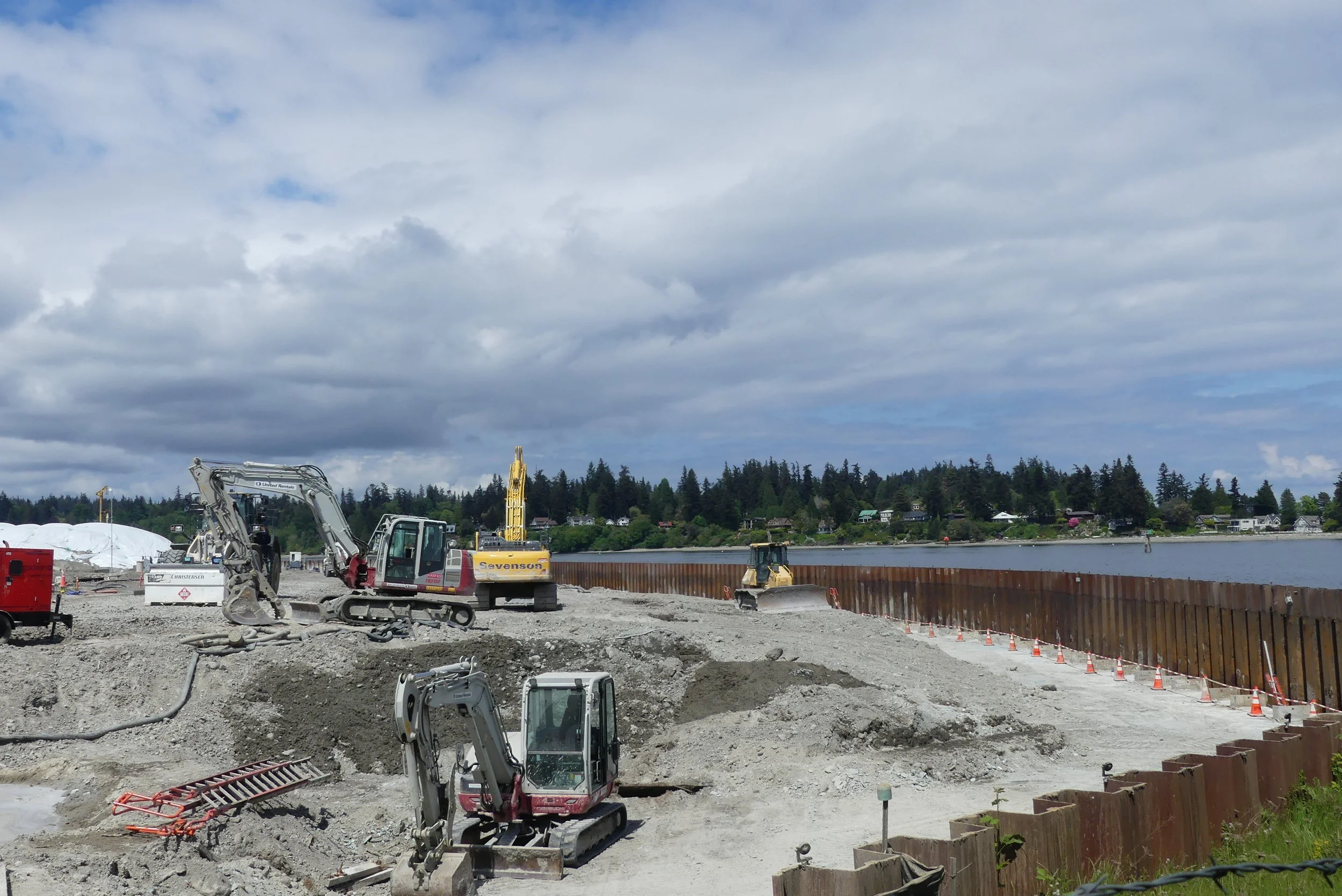
Photo of the ongoing construction of the new containment wall at the Eagle Harbor superfund site. // Photo by Marissa Steward
Creosote is a variety of petroleum-based wood-preservatives with a characteristic chemical odor. Coal tar is the most common of creosote products. Thick, dark and oily, just touching it can leave a chemical burn.
To prepare for construction, logs are compressed under high pressure to burst the internal capillaries. They become a sponge, absorbing and sucking up the injected creosote. The logs, now saturated with preservatives, pose a threat to the sensitive species residing alongside the pilings.
“Creosote is a really good example of where the rubber meets the road in toxicology,” Ian Moran, an assistant environmental science professor at Western Washington University, said.
Environmental toxicology follows a historical pattern: Identify the harmful chemical, determine its toxic effects on organisms and establish a safe level of exposure based on laboratory testing.
“Creosote really challenges that paradigm, because you have hundreds, if not thousands, of different molecules,” Moran said.
Creosote’s complexity makes identification difficult. The evasive nature of the components causes it to stick around in the environment for decades as it biomagnifies, increasing in concentration as it passes from prey up to predator.
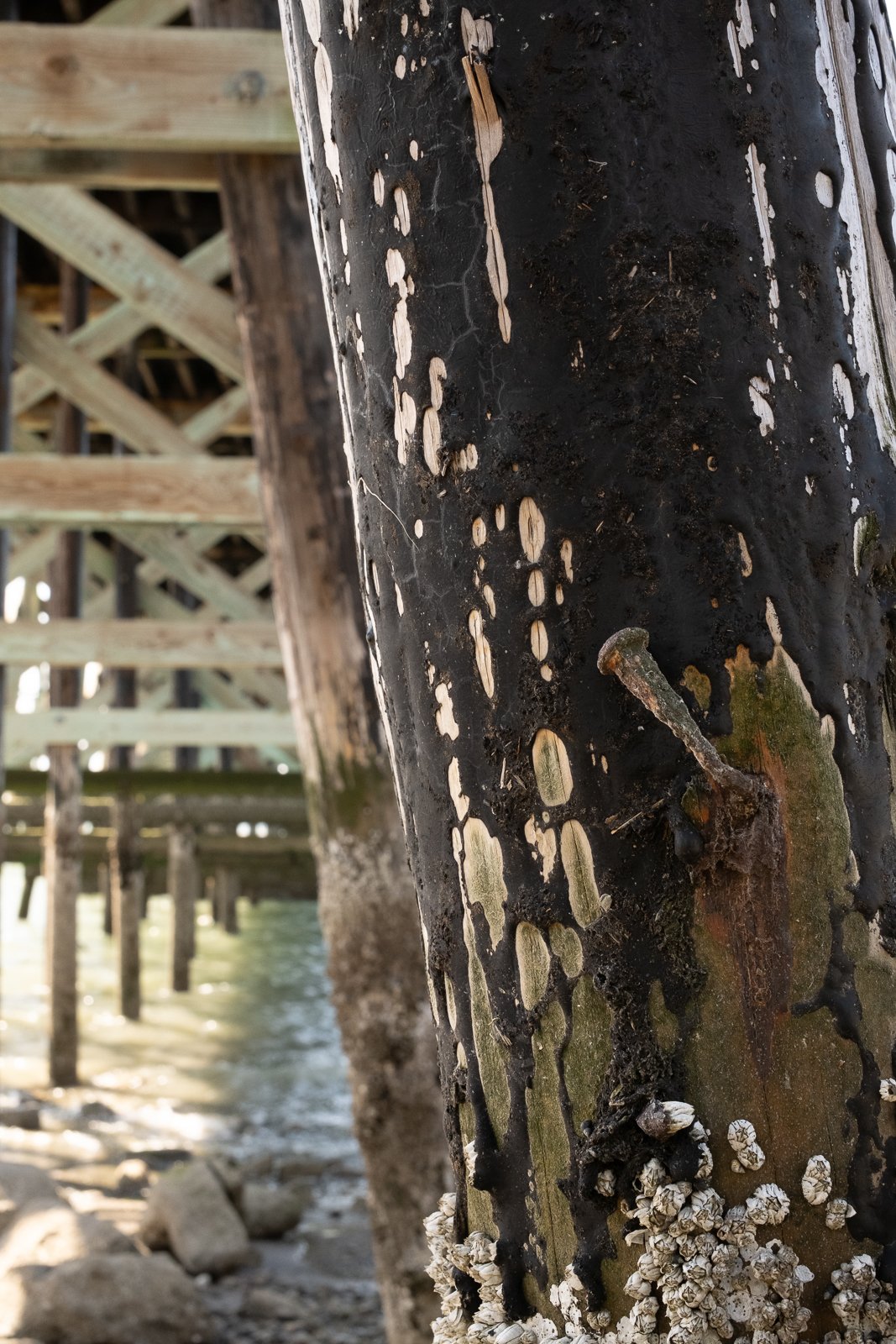
Photo of a piling at Taylor dock in Fairhaven covered in creosote. // Photo by Evan Coleman
It's especially concerning for herring that spawn near creosote pilings. Herring eggs are in a vulnerable developmental stage, making them sensitive to the nearby chemicals slowly leaching from the pilings.
Creosote is now deemed a restricted use product that is unavailable to the public. However, the wood preservative has been used nation-wide for over 100 years, and the damage has been done — leaving sites like Eagle Harbor in its wake.
Before the Bainbridge Island community knew about creosote’s harmful impacts, it was the focal point of their economy. Eagle Harbor was home to the Wyckoff wood-treating facility, operating from 1903 to 1988.
“Creosote was a very big employer here on the island, so for a long time it was linked to this good thing,” Lindsay Ogles, director of exhibits and engagement at the Bainbridge Island History Museum, said.
In the late 1980s, the community’s attitudes began to shift. In 1987, the harbor was officially added to the Superfund National Priorities List by the Environmental Protection Agency.
West Beach, a sandy spot to beat the summer heat, lies on the edge of the site. The sand was added in 2008 as a sediment cap that was installed to keep locals safe from exposure on sweltering days. Although the risk at the harbor has been controlled, some residents remain wary of their safety.
“Learning that the sand is actually there to keep us from getting sick and dying, [I thought] maybe I shouldn’t have been playing there,” Samantha Boulware, a Bainbridge Island local, said.
The EPA is required to communicate with locals about the Superfund Site. Fact sheets about new projects and mailers are sent out to nearby residents, and the Eagle Harbor EPA website also explains how to safely enjoy the beach without risk of exposure.
“We really do care about engaging with everyone,” Zoe Lipowski, one of the EPA’s site project managers, said.
Cleaning creosote is an expensive process, and one that requires great attention to avoid spreading the toxicant further while also preventing exposure. Addressing creosote pilings washed up on a beach requires full personal protective equipment, a respirator and a large plastic tarp to capture the sawdust from the chainsaw.
Extensive cleanup efforts at Eagle Harbor began in 1990 by the Wyckoff company with a focus on contaminated groundwater and sediments. The ongoing work today is led by the EPA.
In 2001, a temporary sheet pile wall was implemented to prevent further contamination into the harbor. The EPA’s current project at the site is to replace it with a more robust perimeter wall that can withstand weathering.
But beyond the hazardous and complicated removal process, the creosote-laden docks hold sentimental value for communities. Decades of families have grown up enjoying the iconic piers. Cleanup can be abrupt, with the site of many memories suddenly fenced off and discarded.
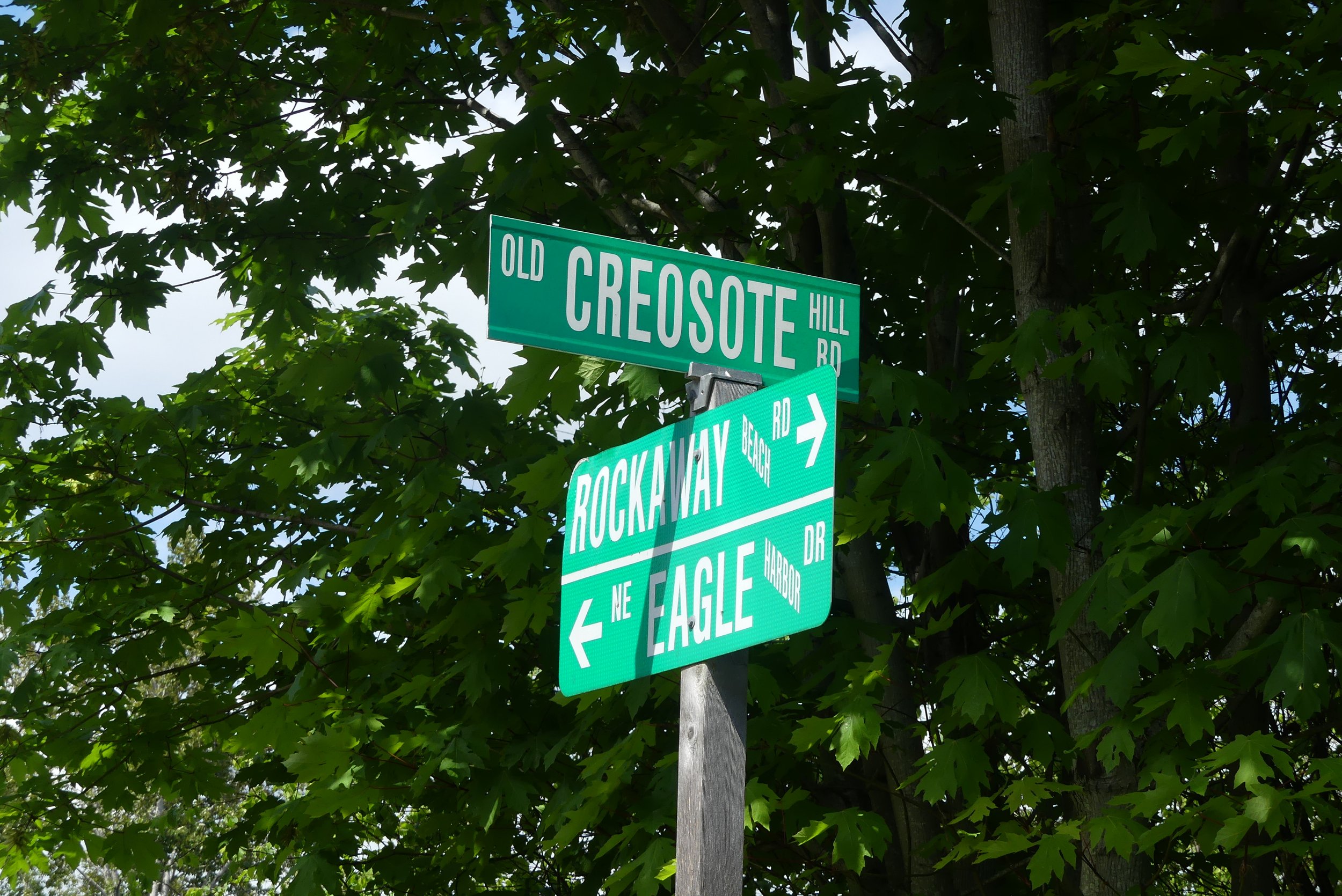
Photo of a street sign in Eagle Harbor, reminiscent of creosote’s legacy and impact on the community. // Photo by Marissa Steward
Moran recalled his first experiences with creosote. The Edmonds Oil Dock, a beloved diving spot for his father, was home to an abundance of anemones, crabs and fish. The dock was built from these creosote pilings and, while causing adverse chemical effects for wildlife, it acted structurally as an artificial reef.
“As a kid, I was devastated that right when I got my scuba diving license at age 12, they ripped out these pilings and destroyed this favorite diving spot,” Moran said.
Despite the harm caused from the facility, locals have sentimental ties to the site. The “plastic low tide” aroma of creosote, as described by Ogles, remains to this day. Most visitors find it unpleasant, but many locals find it nostalgic.
“For people who grew up in the area or worked at the facility, they think of that smell as a smell of their childhood,” Ogles said.
Although the process of removing creosote throughout the Salish Sea is long, complicated and sometimes emotional, spirits are high. As for Eagle Harbor, the future is bright. The EPA is working to hand the site back to the city to become a park.
“I’ve never had a Superfund site get turned into a park,” Lipowski said. “That’s the epitome of what you want your site to come to.”
The Department of Natural Resources developed an app called MyCoast that allows users to report suspected creosote pilings. Today, over 15,000 reports have been made, helping the creosote removal program to plan their next cleanup sites.
Working tirelessly since 2007, the program has removed 21,300 tons of creosote across the state. Robertson estimates half the needed work is complete across the Salish Sea.
“I think I can see an end in sight,” Robertson said.