
Artificial Intelligence, Real Impacts
Students and community members alike reckon with the impacts of generative AI expansion
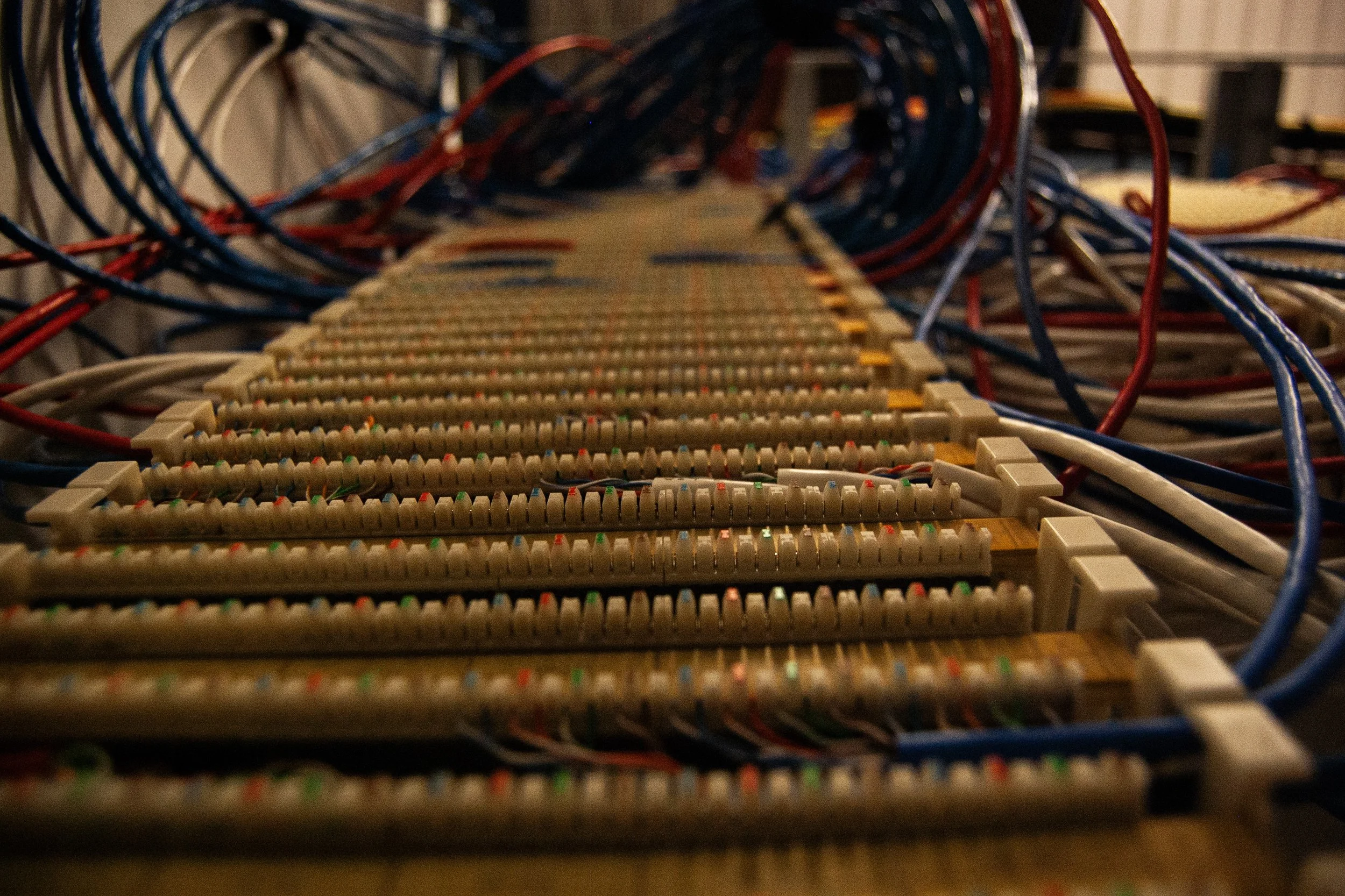
Wires lead into the roof of a server rack in the closets of the computer science facility at Western Washington University, Bellingham, Wash., on Feb. 2, 2026. // Photo by Liam Britt
Story by Kaitlyn Minnotte // Photos by Liam Britt
March 30, 2026
College students have recently gravitated toward artificial intelligence as a powerful new technology to save time and improve efficiency on assignments. But for rural, low-income communities, the construction of energy infrastructure to serve this technology may take its toll on local environments and economies.
In November of 2022, artificial intelligence company OpenAI released its first publicly-accessible demo conversation model: ChatGPT. This generative model quickly became one of the most popular large language models, reaching a million users within one week of its release, and other companies released their own chatbots soon after.
For faculty and staff working in higher education, AI integration is almost inevitable, and many have already begun to explore its boundaries. Justin Revelstoke, the senior software engineer for Western Washington University’s Enterprise Infrastructure Services, sees AI as a promising tool for revolutionizing public education.
“The positive vision for AI is as something that can ask challenging, socratic questions of our students,” Revelstoke said, “but not give them the answer: Give them the attention and the patience, because instruction is a finite resource.”
Students at WWU have begun to abuse this tool, however. According to the university’s Office of the Provost, annual academic violations involving AI have increased from 18 to 63 between the 2022 and 2025 academic years.
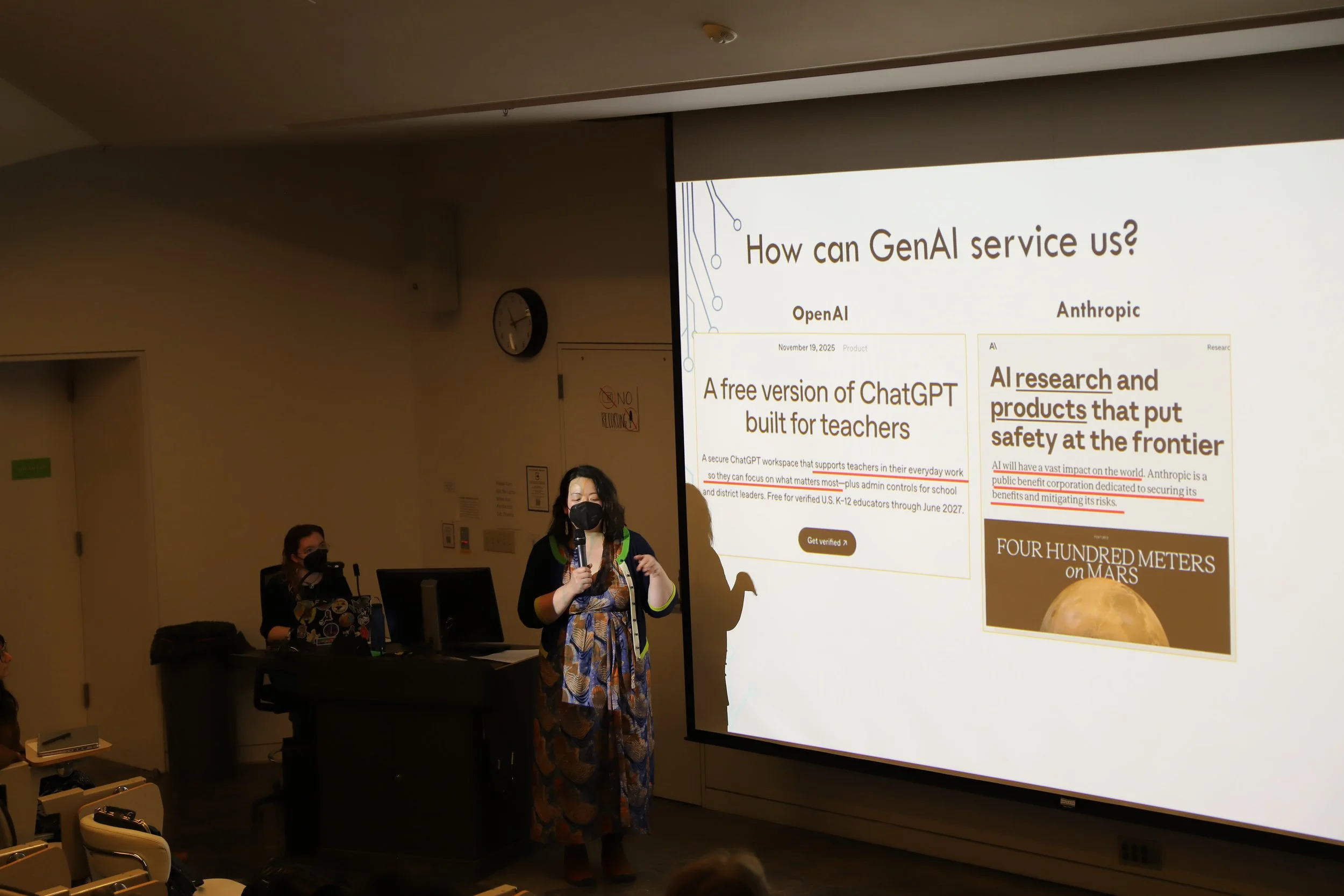
Xi Wang speaks at a teach-in on AI in Education at Western Washington University, Bellingham, Wash., on Feb. 2, 2026. // Photo by Liam Britt
The public concern surrounding generative AI products is often centered on ethical critiques, but many people are also worried about the environmental impacts of AI data centers.
For Anna Olsen, a graduate research and writing assistant at Western, this was one of the first issues she noticed with the rise of generative AI.
“I’m thinking about how the towns that those data centers are in are suffering. Their water is suffering, their electricity is suffering, the humans, the people are suffering,” she said.
Olsen raises concerns that these smaller towns’ current water and energy supplies may not be equipped to accommodate large scale data centers. In 2023, Microsoft acknowledged that 42% of its water usage came from areas already experiencing water scarcity.
Since many large language models are trained on public, open-source information to generate new content, they require significantly more processing power and physical space than most non-AI programs.
As a result, many corporate AI companies have opted for large-scale data centers to meet this need.
Plans to build hyperscale data centers have grown across Washington in recent years, forming large clusters in the central and northern regions of the state. Microsoft has chosen Quincy, a central town of only 5.8 square miles, as a testing ground for increasing their nationwide data center implementation.
Quincy is currently home to 24 data centers, used for both AI and other Cloud storage needs. 16 of these data centers are owned by Microsoft.
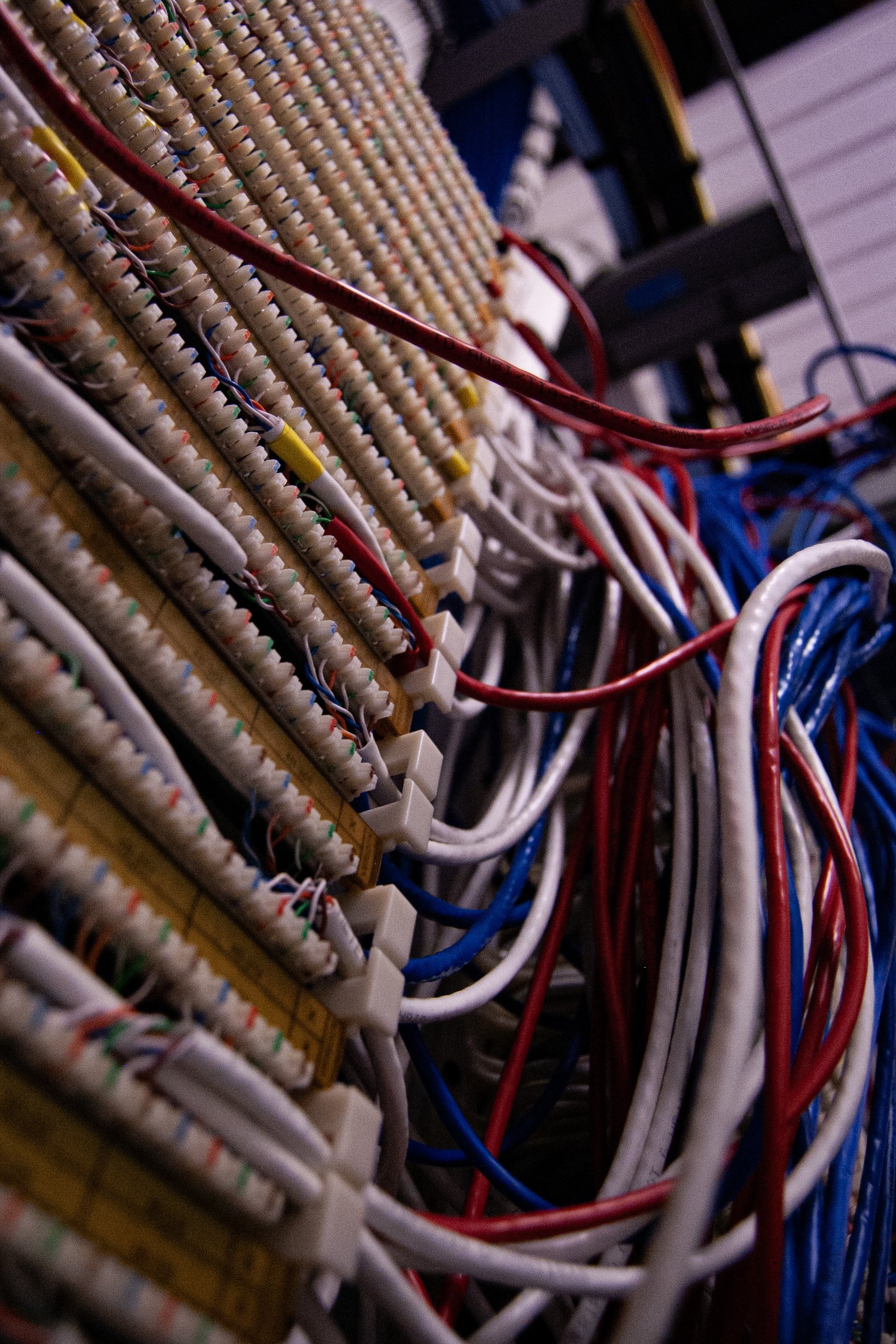
Server racks sit in the closets of the computer science facility at Western Washington University, Bellingham, Wash., on Feb. 2, 2026. // Photo by Liam Britt
Residents of Quincy say that the influx of data centers has contributed significantly to their economy, and will continue to provide more jobs as expansion continues. But with this expansion comes increased energy demand, and many residents are concerned about potential rises in electricity costs.
In January of 2026, Microsoft announced their commitments to improve resource efficiency and ask utility companies to charge rates that are proportional to their impacts.
Despite their promises, some of the Quincy community still holds concerns about the risk of health effects and local infrastructure damage that data centers bring.
For cities like Quincy, with stable access to renewable energy through hydropower and solar infrastructure, the environmental impact of data centers’ energy use is locally reduced. But when the same hyperscale data centers are built in towns that rely on non-renewable energy, the costs can be much higher.
In states like Virginia and Tennessee, with high concentrations of data centers and a lack of renewable energy infrastructure, communities that live near coal plants and data centers face this difficult reality. Residents of these towns report heavy air pollution and land encroachment from these plants and centers.
Dr. Xi Wang, an assistant professor in the Institute for Energy Studies and Environmental Studies departments at Western, believes that an influx of data centers may slow down our climate progress.
“Because new power generation and transmission infrastructures take time to build, the high energy demands of AI data centers may mean that coal power plants that were slated for closure may be kept running longer,” Wang wrote in an email. “This is bad news for both climate change and for the communities — often rural, often marginalized — living around these plants.”
While much of the concrete evidence of discrimination is preliminary, recent national studies have shown a correlation between data center location and social vulnerability indicators like poverty and lower education levels.
According to the 2020 U.S. Census, Quincy residents have an average annual income of $31,110, which is much lower than the average Washington state residents’ $53,744 per year.
As they expand AI infrastructure into rural communities like Quincy, Microsoft and OpenAI are also currently producing two of the most popular generative AI chatbots on the market: Microsoft Copilot and ChatGPT. These chatbots, especially Microsoft Copilot, have been integrated extensively into the platforms that many students use for studying, writing and entertainment.
At Western, the Copilot chat and Teams extension have both been enabled for faculty, staff and students, with safeguards around access to personal and confidential information. The environmental cost of using these chatbots, however, falls on those who live closest to these data centers: rural, low-income families.

Computers line up in a classroom on Western Washington University’s campus in Bellingham, Wash., on Feb. 10, 2026. // Photo by Liam Britt