
Sprucing Up the City
Landmark tree protections help shade the way for a greener Bellingham
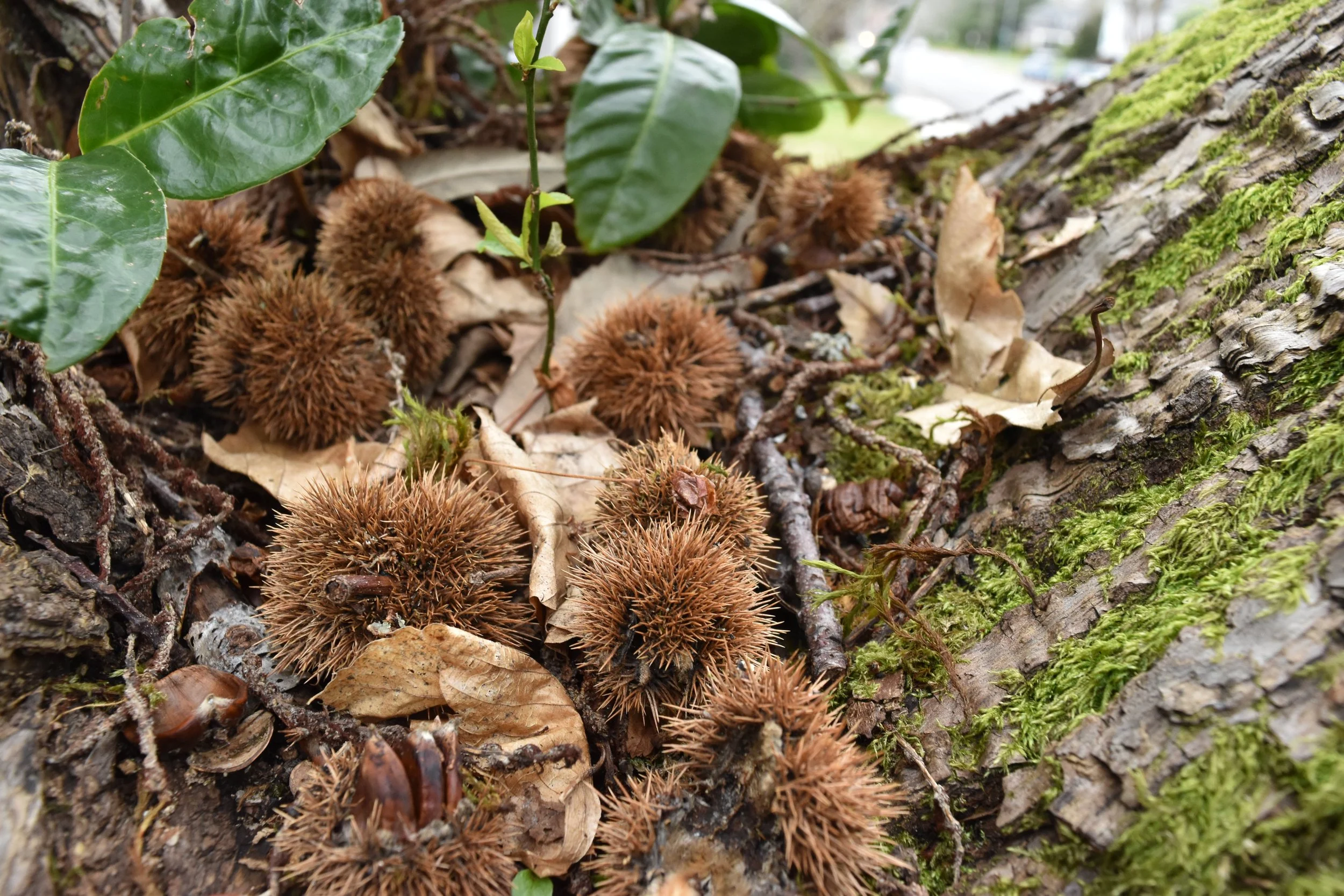
Spiky seed pods rest in the forked trunk of a protected chestnut tree. // Photo by Ben Stebbins
Story by Ben Stebbins // Photos by Ben Stebbins, Harley Brown & Kaia Olson
March 30, 2026
Youch!
That’s what you might utter after stepping on a Chinese chestnut seed pod. Those pesky, porcupine-like balls of fury can turn a relaxing barefoot stroll in the yard into a memorable hobble.
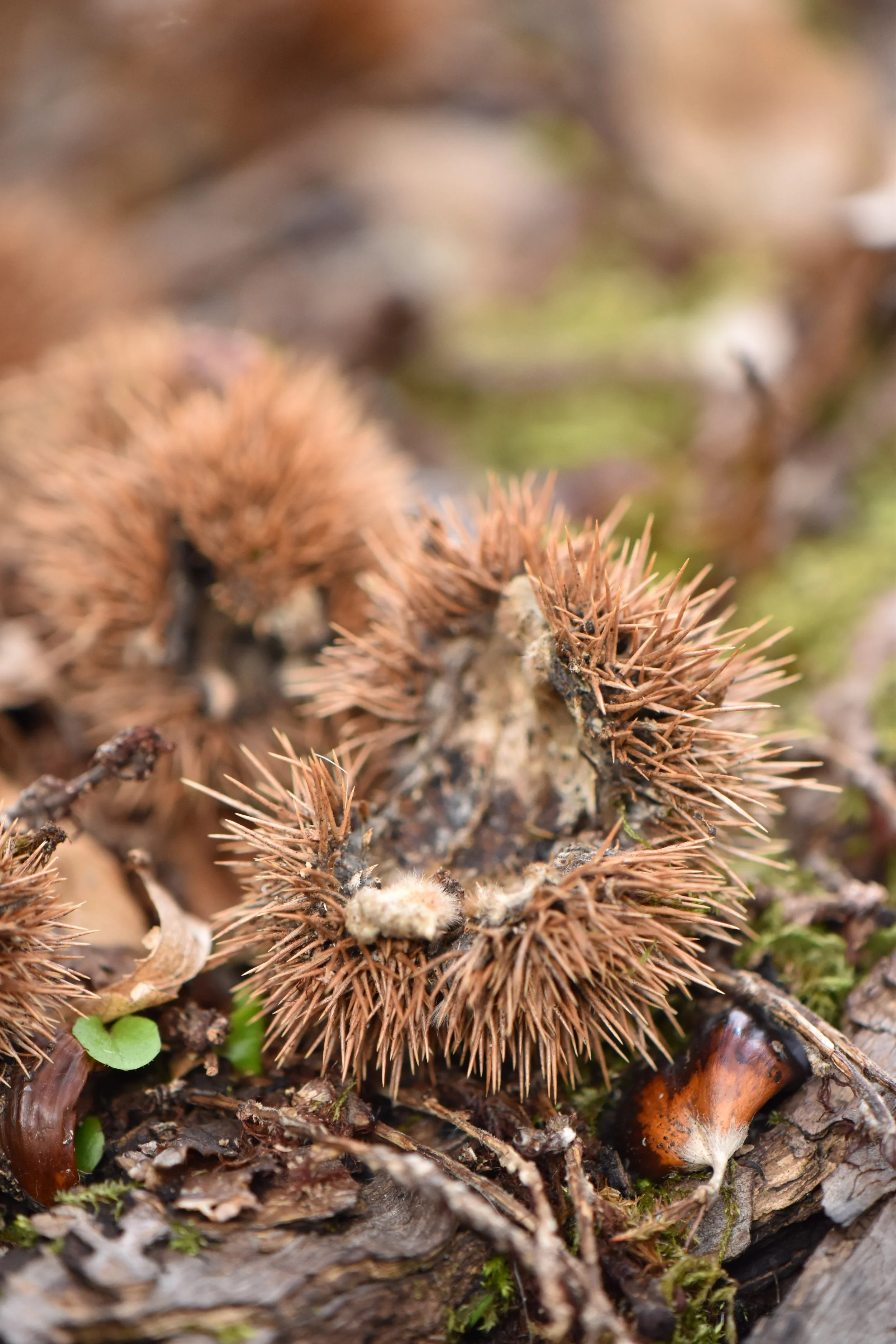
A chestnut seed pod opens wide. // Photo by Kaia Olson
“If you step on them when you’re not wearing shoes, that’s when you feel it,” Austin Chomka, a Bellingham resident who lives near such a tree, said.
Removing a tree with hundreds of barefoot-threatening spikeballs seems like the solution. But urban wildlife, like squirrels, that love that big ol’ tree would lose some of their favorite habitat. This isn’t just true of trees with seeds that pedestrians would prefer to avoid. Trees help create special places in neighborhoods for people and animals alike.
The Chinese chestnut tree is healthy, bringing life and shade to the street. In a way, the spiky seed pods add an element of character to the sidewalk. The City of Bellingham plans to legally protect that character.
On May 20, 2024, the city enacted an interim emergency ordinance, not for typical emergency concerns, but to protect the trees that give Bellingham its charm. Bellingham City Council voted unanimously in February 2026 to extend the ordinance another six months.
Trees with a trunk diameter at breast height of 36 inches or larger that are in healthy condition are automatically considered a landmark tree. That threshold is not the only consideration. Community members can nominate other trees that have cultural or community significance for addition to the inventory.
While aesthetics are important for sightline views and sprucing up streets, trees provide important benefits to city residents and wildlife alike.
A 2022 study on old growth trees found that old trees and forests create irreplaceable habitats and microclimates, fix atmospheric CO2 and produce oxygen.Trees and forests provide habitat for many different species. It’s where stellar jays make a racket, chickadees sing their tunes and squirrels find a safe haven.
“A tall Doug fir really adds a three-dimensional habitat space that wouldn’t exist otherwise,” Ralph Riley, a forest ecologist, said.
Urban forest canopies are one part of green infrastructure systems that provide environmental benefits in an urban setting and promote human wellbeing. A study on urban trees and human health found that with forest and tree immersion, depression and fatigue decreased, especially for individuals who initially had high levels of stress.
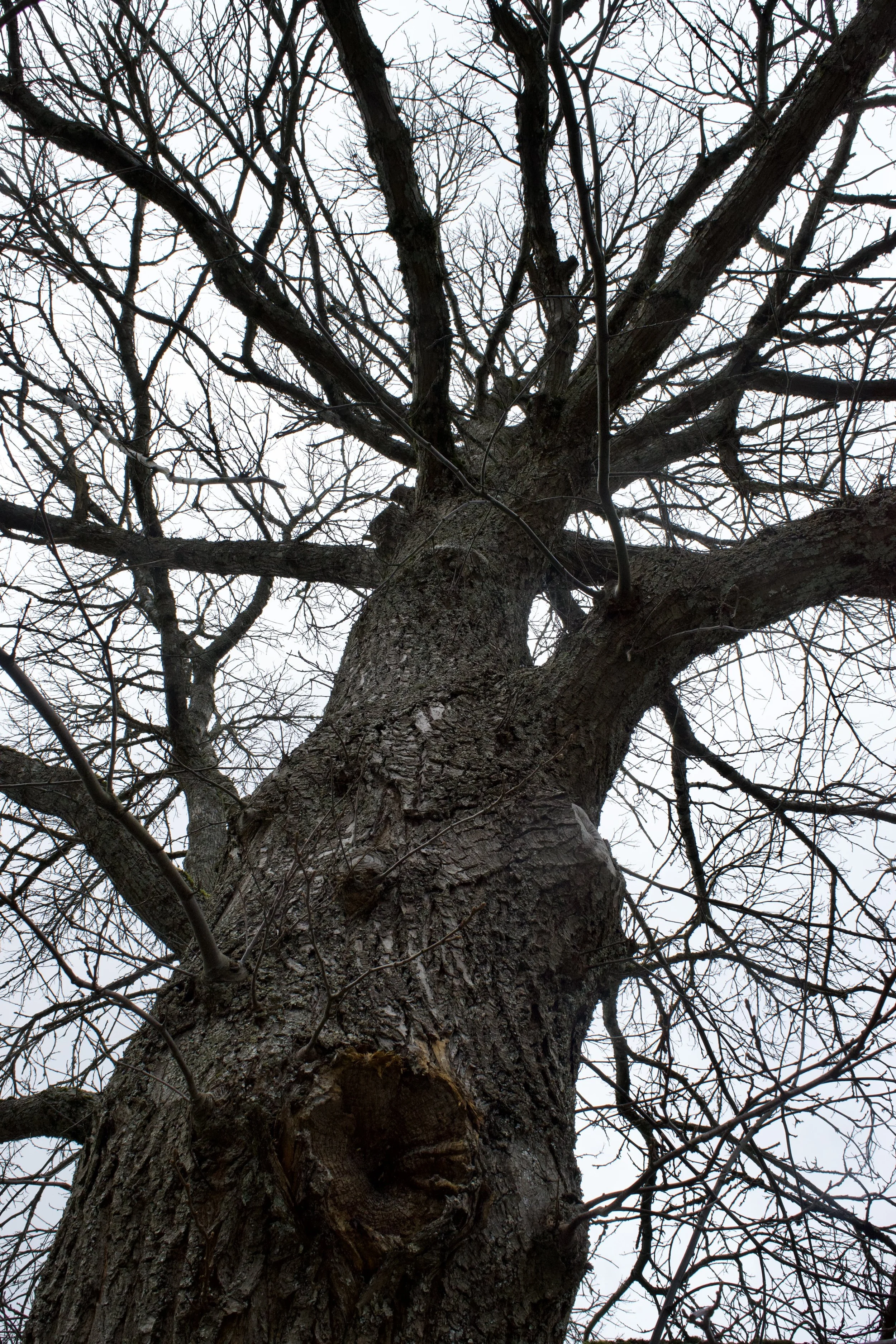
One of the designated trees protected by Bellingham’s emergency ordinance, a Chinese chestnut’s canopy stretches above Billy Frank Jr. Street. // Photo by Kaia Olson
Furthermore, the heat island effect is mitigated by trees. Asphalt doesn’t absorb heatwaves as efficiently as soil and other natural ground covers. Reflection of those heatwaves heightens temperatures of cities compared to forested park spaces.
“Trees provide shade, shade helps reduce the amount of solar radiating off of hard surfaces and increases the amount of ambient heat in the area,” Blake Lyon, the planning and community development director of Bellingham, said.
Additionally, tree roots stabilize the soil and filter storm water, which runs off into either Bellingham Bay or is reintroduced into Lake Whatcom, Bellingham’s drinking water.
“When you have a lot of complicated sort of forests inside urban environments, you're really improving water quality, you're improving soil stability,” Andy Bunn, a Western Washington University professor who runs the tree rings lab, said.
Possibly the most known benefit of trees is their ability to produce oxygen and absorb CO2.
“What forests can do is they can help take carbon out of the atmosphere and hold it for a while. If a tree is going to live for hundreds of years, the carbon that gets removed from the atmosphere gets stored in the plant,” Bunn said.
Bunn emphasized that trees alone cannot offset climate change all by themselves, but they can be part of the solution. A singular landmark tree is not going to save Bellingham from climate change. But, that’s why the step of tree protection is important. Trees are strong in numbers — longevity, growth and the spread of older trees is what helps to influence change.
The city’s overarching goal is to achieve a canopy cover of 45% by 2050. As of 2018, that coverage sits at about 40%.
A 5% increase in 32 years doesn’t sound like much, but with the city’s growing population, more housing needs have to be met. To build new housing, oftentimes trees have to be cleared, all while the protection of trees is vital for reaching the goal. Lyon said it’s a balancing act to take into account city and environmental needs.
“I think the department really is trying to represent the values of the community as a whole,” Lyon said.
While tree removal is sometimes necessary for housing construction, safety concerns are also taken into account. An unhealthy, dying, diseased or unstable tree can pose a safety risk to people and infrastructure.
“Big trees, when they fall down, can do a lot of damage,” Riley said.
The removal of trees with goals to upkeep and increase the urban forest is tricky. But the community can take the opportunity to volunteer and contribute to offset the removed trees in many ways. Volunteer work parties are put on by the city and non-profit organizations to plant new trees. Community participation at those events is what leads to the fostering of the next generation of old growth trees.
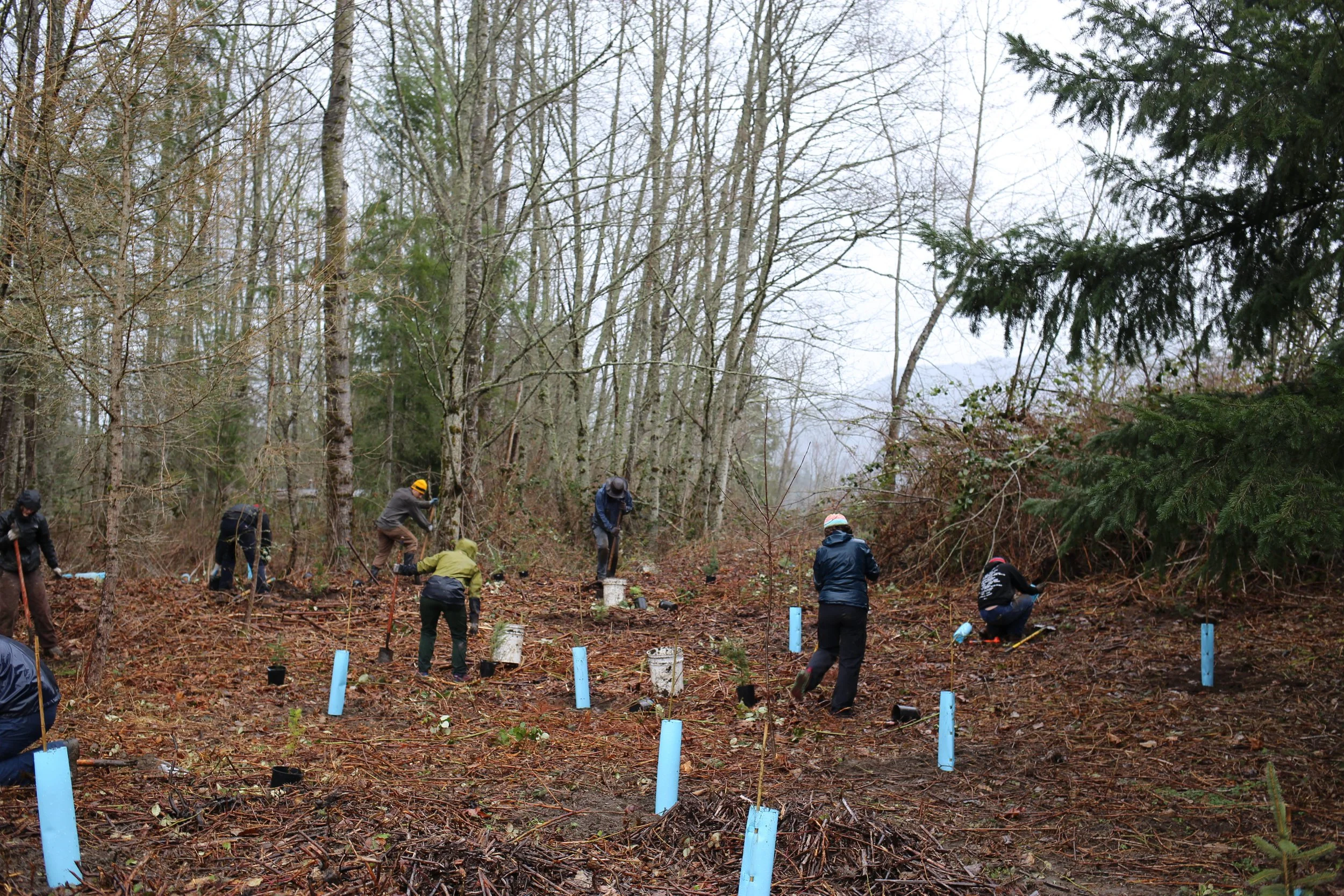
Volunteers plant trees at a NSEA work party. // Photo by Harley Brown
Feerer said that tree planting is a slow going process. Whatcom Million Trees has protected 493,129 trees and planted 5,861 as of March. The preparation, planning and planting of trees takes a significant amount of effort. The protection and preservation of established trees is, in a sense, easier than replanting what’s been lost.
The Nooksack Salmon Enhancement Association is another non-profit that plants trees with the help of volunteers throughout Whatcom County. Notably, NSEA has been returning to some restoration sites for many years.
Sarah Brown, NSEA’s stewardship program manager, engages citizens through the NSEA Stewardship Program with work parties and community involvement.
“We really encourage people to learn more and be informed and participate when there's opportunities to participate,” Brown said.
A combination of protection and restoration is essential for maintaining healthy ecosystems. If these tree protections become permanent, that Chinese chestnut and its spike-balls of doom — along with all the other healthy landmark trees — won’t be leaving any time soon.