
Troubled Waters
As the Nooksack River delta expands and habitat conditions shift, longfin smelt remain elusive
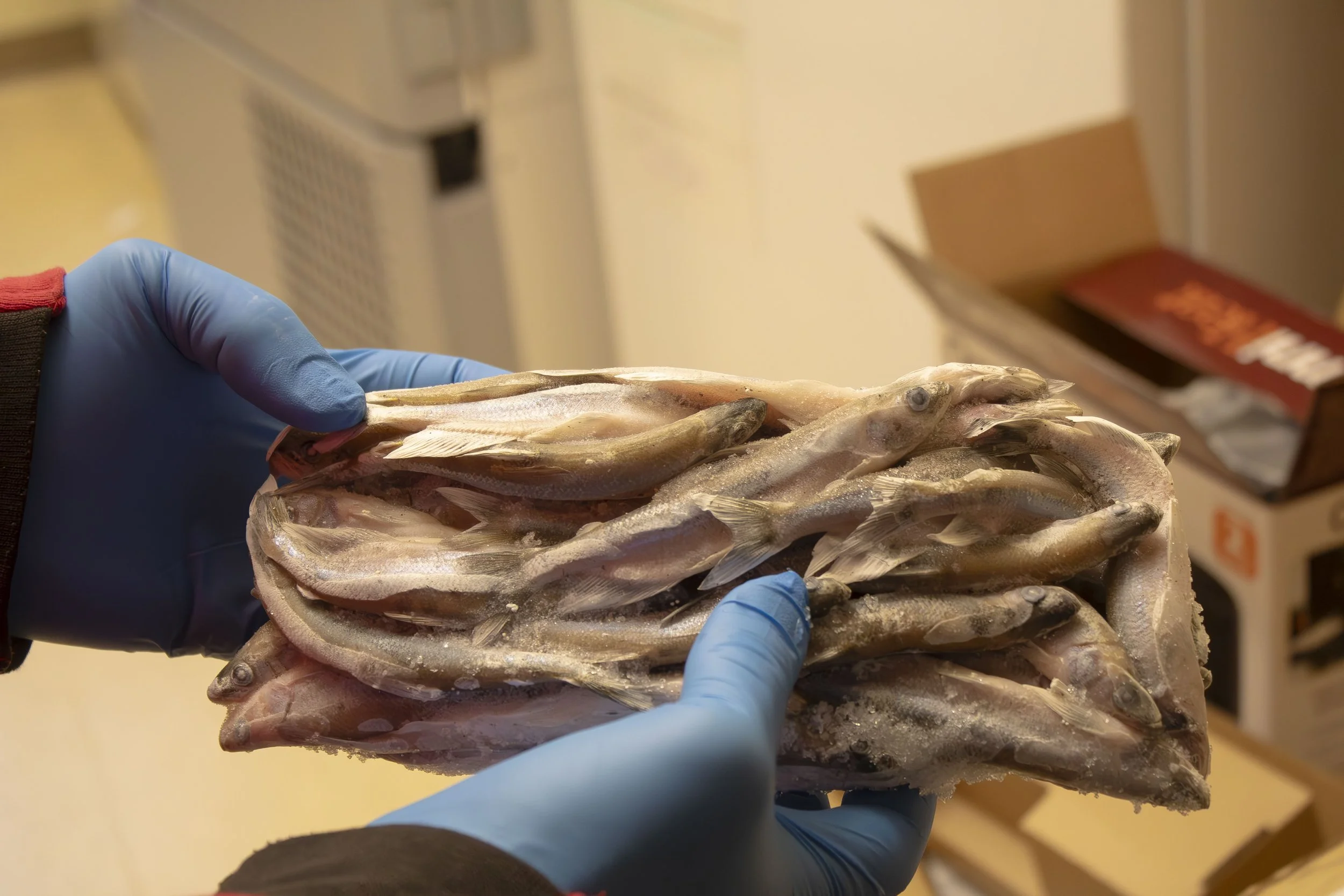
Frozen hooligans at the Salish Sea Research Center used for eDNA research, Jan. 30, 2026. // Photo by Elena Delgado
Story by Grace Weller // Photos by Elena Delgado
March 30, 2026
Tumbling down from the Cascade Mountains and winding through Whatcom County, the Nooksack River flows out into Bellingham Bay. Researchers remain uncertain as to why it’s one of the only places in the state that longfin smelt call home.
“They’re still a very mysterious fish,” Jeff Solomon, a member of the Lummi tribal fishing community, said. Solomon assists with ongoing smelt research at the Salish Sea Research Center.
Longfin smelt, known locally as hooligans, are an anadromous species of forage fish. While they live most of their adult life in a marine environment, they spawn and hatch in freshwater ecosystems. They may have the most geographically restricted spawning habitat of any anadromous forage fish in the Puget Sound Basin, with spawning isolated to the Nooksack river system.
Hooligans have existed in the Nooksack since time immemorial, historically harvested by the Nooksack and Lummi tribes. Each year, as the hooligans migrated into the river around mid-November, feasts were held to mark their importance as a traditional food source. The yearly practice of the hooligan harvest is a longstanding custom — one that is still significant to surrounding communities.
However, Lummi elders have noticed a decrease in hooligan presence in recent years, prompting scientists at the Salish Sea Research Center on the Northwest Indian College’s campus to investigate.
Operating through a National Science Foundation grant, John Rombold, associate director of the center, works with Solomon and other scientists to conduct environmental DNA research in the greater Salish Sea and the Nooksack River.
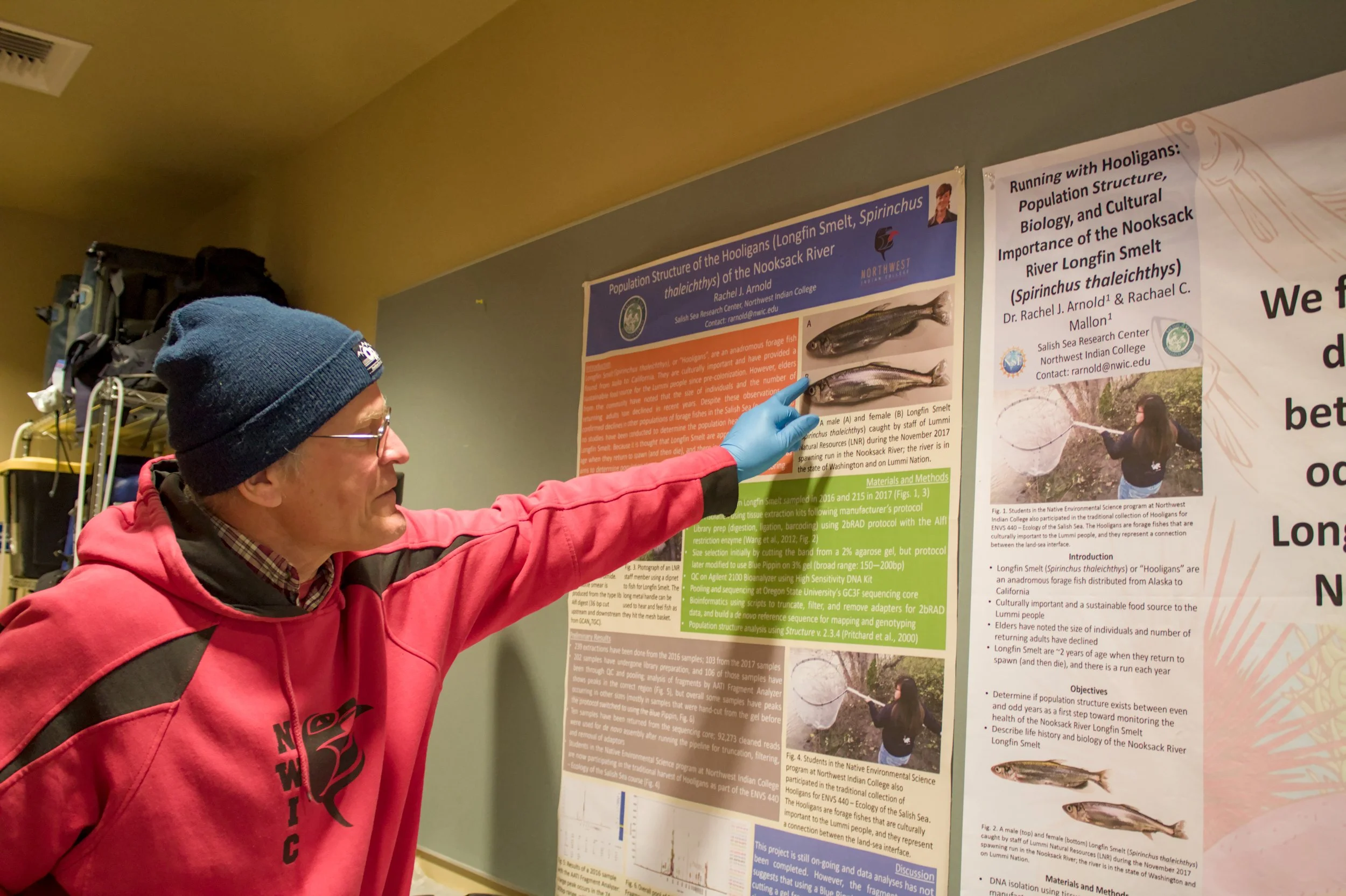
John Rombold, associate director of the Salish Sea Research Center at the Northwest Indian College, pointing at a diagram on hooligans. Jan. 30, 2026. // Photo by Elena Delgado
Environmental DNA, or eDNA, is shedded genetic material that can be used for species detection. It is especially helpful for elusive creatures like hooligans that utilize multiple habitats throughout their life stages. Researchers can use eDNA to gain insights into species distribution and relative abundance.
“We find them everywhere, but they seem to be abundant nowhere,” Rombold said.
Another variable shaping this confusion is the expansion of the Nooksack River delta. As large amounts of sediment and debris are being swept downriver, the delta along the north curve of Bellingham Bay is expanding at a rapid pace.
Each year, the delta grows by roughly 50 feet.
“River conditions have been getting so extreme the past couple of years that there’s a lot more erosion that’s occurring, and it’s causing more and more build up downstream,” Solomon said.
With recent record-breaking precipitation events and devastating flooding lining up with hooligan spawning season, egg clutches this year are potentially at risk, facing the possibility of being crushed by hurling debris or swept out to Bellingham Bay.
However, scientists at the Salish Sea Research Center are hopeful about the adaptational abilities of the hooligans.
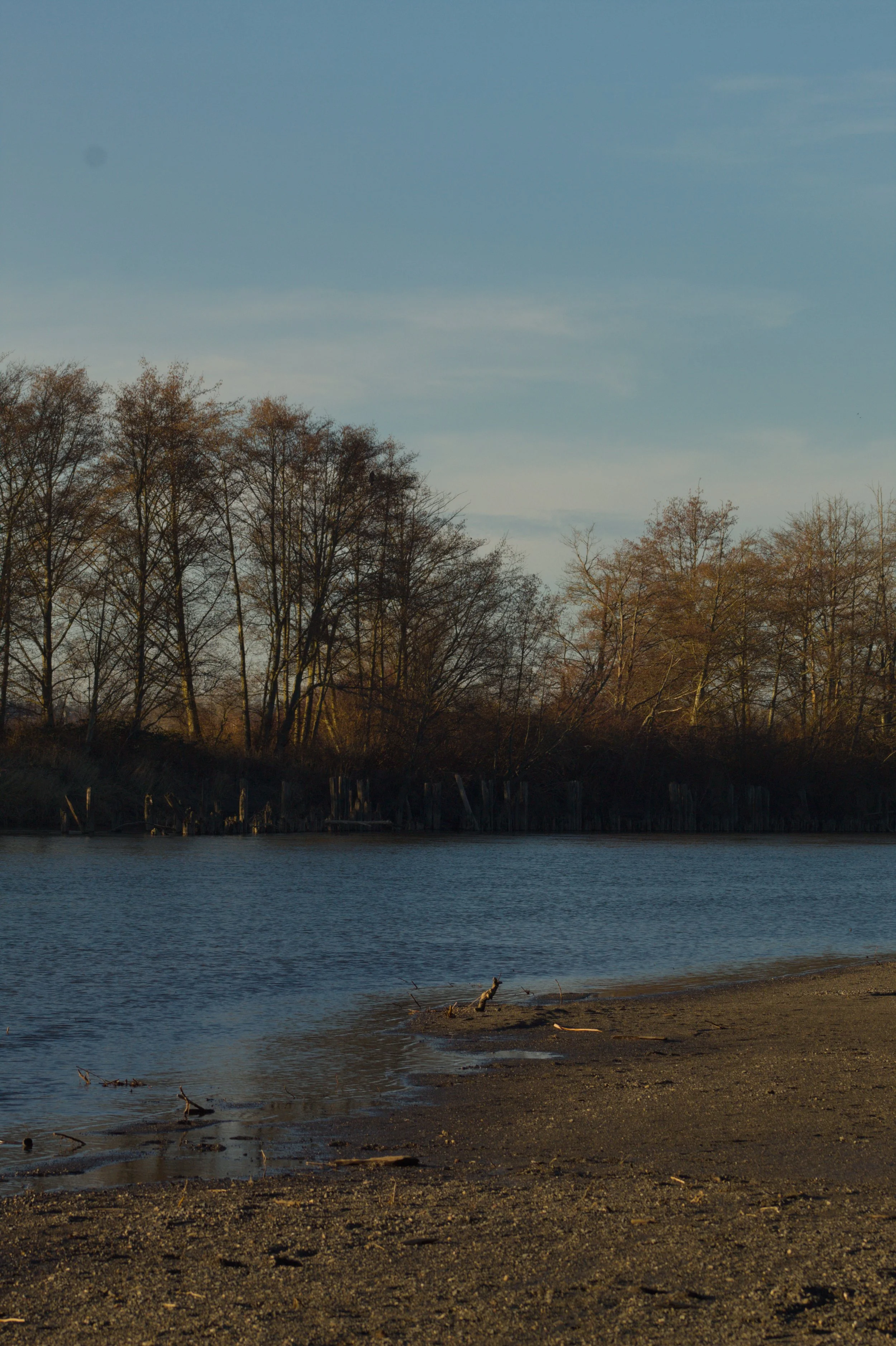
The sandy banks of the Nooksack River, March 2, 2026. // Photo by Elena Delgado
“Every species has to be resilient, especially in a dynamic environment,” Rombold said.
While turbid river conditions pose a threat to egg clutches, it appears that the ever growing delta may be providing a swath of new spawning habitat that is safer from human activity and the radical flooding events of the river.
During the spawning season, a large amount of hooligan eDNA appears to be concentrated in the delta, a trend that has been observed over the past couple of years. Whether the detection of eDNA in the delta is a result of spawning dynamics or migratory patterns is still to be determined.
“These days the river conditions this time of year can get so extreme, that to me it makes sense for them to have to adapt and find areas to spawn where they’re not going to be scoured out,” Solomon said.
Factors such as salinity, turbidity, nutrient availability and the presence of aquatic organisms may influence where the hooligans reside. Having an understanding of the necessary habitat requirements can inform future research on hooligans and the Nooksack River ecosystem at large.
For Mark Tagul, a marine biologist and co-owner of Tagul Oceanic, the importance of forage fish such as hooligans cannot be understated. A permanent decline in hooligans and other smelt species would have devastating effects on the entire food web of the greater Salish Sea region.
Salmon in the Salish Sea rely on smelt for an oily, rich diet to build fat deposits, which make them nutrient-dense food for orcas, according to Tagul. In the absence of smelt, salmon may switch to an alternative, more abundant but less fatty, food source, weakening the already-threatened orca populations.
“That's ecology for you, there's so many different ways to look at it,” Tagul said. “It’s never cut black and white.”
While scientists are focusing their efforts on understanding hooligans, there are few definitive answers. It is possible that only time will tell what the impacts of the expanding delta and changing habitat will have on hooligan populations in the Nooksack.
As Solomon says: “There are still dozens and dozens of unanswered questions.”